18 Feb, 2026
Feel free to reach out to us.
18 Feb, 2026

This article is medically reviewed by Dr. S. Bhattacharjee, Senior Consultant - Radiation Oncology, HCG Cancer Hospital, Bangalore.
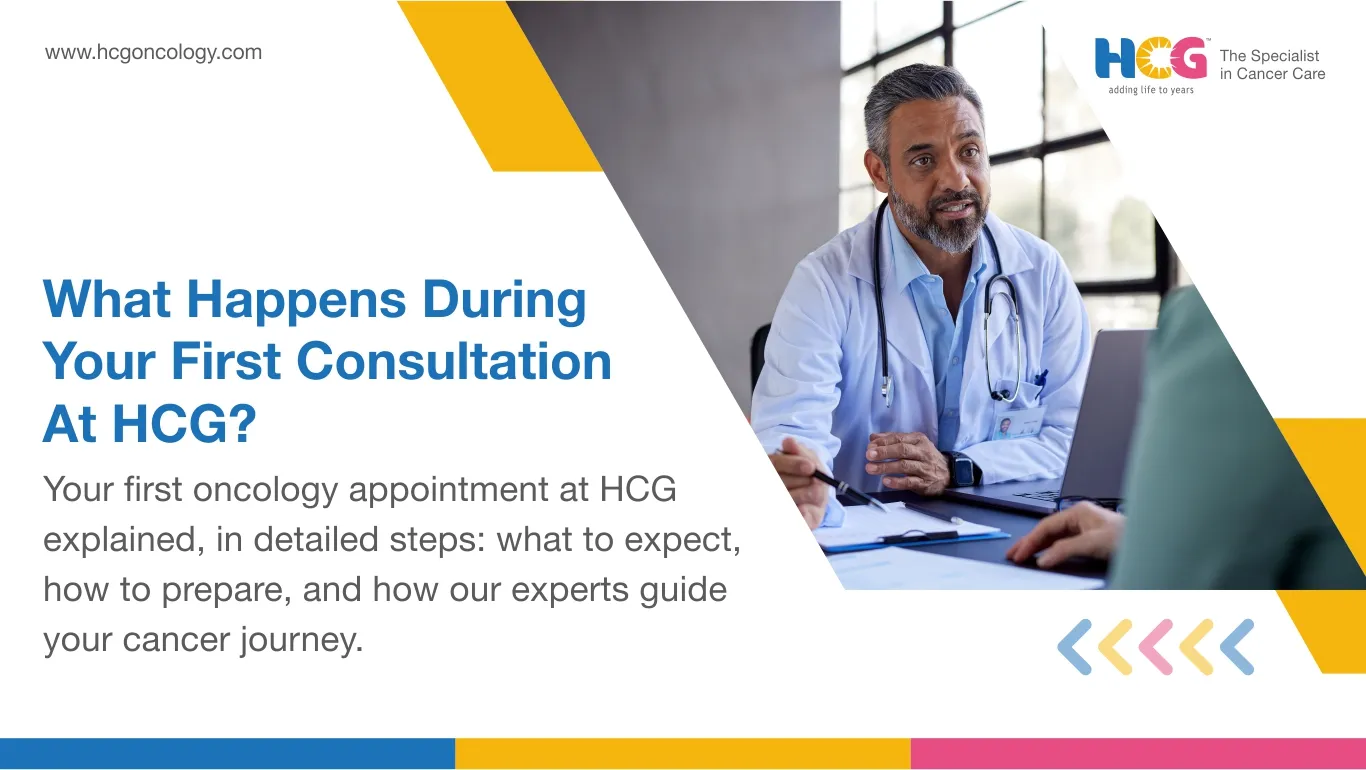
Are you preparing for your first oncology appointment?
It can be overwhelming, and we understand you. So, we made a detailed guide on how to prepare for and what to expect from your first oncology consultation.
This guide aims to provide you with a sense of clarity on what to expect and help you make informed health decisions and avoid unnecessary confusion.
The primary goal of this appointment is to find out more about your health, discuss the symptoms you are experiencing, assess available diagnostic information, review your personal and family medical history, and plan the next steps.
During your first oncology visit to HCG, our specialists will ensure that you feel seen, heard, and supported, and leave the hospital with a clear plan of action.
Read on to learn how to schedule your first cancer appointment at HCG.
A first oncology appointment, or first cancer appointment, is nothing but your first visit to a hospital to consult an oncologist, a doctor who specializes in the diagnosis, treatment, and management of cancer.
In most cases, you will be referred to an oncologist by a general physician when they come across the signs or symptoms that indicate cancer. However, in other instances, patients may choose to consult an oncologist on their own.
During your first cancer consultation, depending on your referral or the type of cancer you are suspected of having, you may see a medical oncologist, who recommends systemic therapies, like chemotherapy, targeted therapy, or immunotherapy; a surgical oncologist, who treats cancer through surgery; or a radiation oncologist, who manages cancers through radiotherapy.
Before booking your first oncology appointment or understanding the process, it is essential to understand the different scenarios that can make an individual consider getting an oncologist appointment.
At HCG, individuals coming to see an oncologist fall into one of the following four categories:
1.Confirmed Cancer Cases:The cases where patients have already received a confirmed diagnosis elsewhere, and they are visiting HCG for a second opinion second opinion or to undergo treatment. In such cases, our specialists at HCG will verify the diagnosis with additional genomic and cytogenic studies. Based on the conclusive diagnosis, a second opinion or treatment recommendations will be shared.
2.Doubtful Cases:The cases where patients have partial information about their condition or have incomplete reports, which may be unclear. These patients will be asked to undergo additional pathology tests and advanced imaging tests for a conclusive diagnosis and subsequent treatments.
3.Undiagnosed Cases:Those cases where patients have symptoms but are unsure if they have cancer and have not undergone any tests for cancer detection. For such cases, doctors at HCG recommend a detailed investigation, involving mammography, biopsy, and imaging tests for a confirmed diagnosis, which will be followed by customized treatment planning.
4.Proactive Prevention Cases:Those cases where individuals proactively meet specialists to understand their cancer risk and learn about different preventive measures they can take against cancer, which may include lifestyle modifications and cancer screening.
Being prepared is very important to make sure that you get the most out of your first oncology visit. Preparation can help you stay calm, have smoother discussions, and make informed health decisions.
Here are some first oncology consultation tips to help you with scheduling and preparing for your first oncology appointment at HCG:.
How To Schedule
There are multiple ways you can schedule your first appointment with our oncologists, and they include:
Through the Website:Please visit the HCG website, where you can book your appointment through live chat with our AI assistant on the website, WhatsApp support, or by filling out the appointment form on our website.
Through the Mobile App, HCG Care:HCG Care,a patient-friendly mobile app by HCG, allows you to book an appointment with a specialist of your choice with just a few clicks. This app is available both on the Google Play Store and the Apple App Store.
Through the Call Center:You can also book an appointment with our specialists by giving us a call on our centralized call center number, +91 74064 99999, where our care officers will understand your requirements and help you find the right specialist.
Through Direct Walk-in:You can also directly walk into the hospital and speak to the patient help desk to know which oncologist is available for consultation and accordingly schedule your appointment.
Things to Keep in Mind While Scheduling Your AppointmentIf you wish to consult a specific oncologist or an oncologist from a particular discipline, please inform our care officer, and they will help you accordingly.
If you are willing to meet the specialist virtually, please inform the care officer. Our mobile app allows you to select the virtual consultation option when you are booking your appointment.
The hospital may send you a reminder the previous day or on the day of the appointment.
If you are not able to make it to the appointment for any reason, please inform the hospital so that they can help you book one at a different time.
How To PrepareThe more prepared you are before the visit, the more fruitful your discussion will be with our specialists. Here’s how to prepare for your first oncologist visit:
Write down your symptoms, when you started experiencing them, and any changes you've seen.
Have a list of all the medications you take, which includes your prescription and over-the-counter medications and supplements.
Have a list of past illnesses, chronic conditions (such as diabetes or high blood pressure), allergies, and surgeries you've had.
If you know of a family history of cancer or other hereditary diseases, make a note of those, too.
If you can, ask someone to go with you for support and to help you recall things better.
Additionally, you can make a list of questions to ask, like the ones listed under the section, “Key Questions to Ask an Oncologist During a First Visit.”
Documents to Carry for Your DiscussionDuring your consultation, you may be asked for your old pathology reports or scanning reports. Having these documents in one place can help you have a swift consultation experience. The following is the oncologist appointment checklist for documents you may have to carry:
A letter from your primary care doctor (if you have one)
All historical medical records that are important to the current issue
X-rays, ultrasounds, CT scans, MRIs, and PET-CT scans on CDs or USBs
Pathology reports and slides or paraffin blocks, if you have them
The results of blood tests, including a complete blood count, liver and kidney function tests, and tumor markers, may also be included.
Proof of ID and insurance (for registration purposes and treatment-related discussions)
Any old biopsy reports or notes from the surgery
Generally speaking, a first oncology appointment has a set framework, which involves clinical evaluation, reviewing material, and discussion on next steps. However, it can change to fit your requirements.
Here's what happens at your first oncology appointment:
On the day of your appointment, get to the hospital about 10-15 minutes early. Once you are in, you should check in at the outpatient desk.
At our hospital, we have patient coordinators who can help you prepare medical records for the cancer doctor and fill out necessary medical forms.
Usually, your consultation occurs at the said time; however, sometimes, you may have to wait for your appointment, especially when there is a high patient volume or if the doctor has some emergency cases to look into.
As you enter, our specialist will greet you. Once you are comfortably seated, our specialist will begin the discussion. They may first ask about your symptoms and the length of time you have been experiencing them. They may also ask what prompted you to see an oncologist. After this, the discussion will slowly proceed to your and your family’s medical history.
Medical history assessment plays an important role in identifying your individual medical risk, devising treatment plans, and predicting disease prognosis. Your medical history assessment may include a discussion of the following factors:
Previous diseases, drugs, and allergies
Family history of cancer
Your day-to-day activities in domestic and professional settings
Additionally, factors like social support, employment, and housing conditions may also be discussed, as these factors impact the next steps, i.e., treatment planning and treatment delivery.
After evaluating your medical history, the doctor may go over imaging and pathology reports with you. They will explain the diagnosis, the type of tumor, and the stage as much as possible if the pathology (biopsy) is clear. The oncologist may suggest more testing if the reports are incomplete or if additional reports are required for a conclusive diagnosis.
The doctor may also conduct a physical examination, taking into account your symptoms and the suspected affected organ system. A physical exam is considered one of the first steps of a cancer diagnosis.
At times, the doctor may recommend specific diagnostic tests if diagnostic information is incomplete or if there have been no diagnostic tests done. These tests are necessary for them to arrive at a conclusive diagnosis: BI-RADS scoring for breast cancer Imaging tests (different types of PET scans, MRI scans, etc.) Genomic testing Circulating tumor cells (CTC) test Liquid biopsy tests and other biopsy procedures Blood tests for tumor markers and organ function assessments If systemic therapy is anticipated, baseline examinations of the heart, lungs, or bone marrow may also be recommended, as some cancer drugs can negatively impact the outcomes in patients with co-morbidities associated with these organs.
New reports may take anywhere between a few minutes and four weeks to arrive, depending on the type of test recommended and its complexity. To show these reports to the doctor, the patients may have to schedule another in-person or virtual appointment.
Scores 1-3 indicate benign findings; score 4 indicates a 50-60% chance of cancer; and score 5 indicates a 90% chance of cancer. For BI-RADS scores above 4, a biopsy will be recommended.
At HCG, we use targeted or highly specific radiotracers for PET scans; this improves the quality of diagnostics and reduces the risk of false positives. Our doctors may recommend FAPI scan, DOPA or methionine PET, PSMA PET, F18 bone scan, etc., for detailed evaluation, along with disease staging and treatment planning.
At HCG, genomic testing is recommended in younger individuals, as cancers detected at a young age are often aggressive, and understanding which gene is driving cancer growth can help in planning effective treatment.
The circulating tumor cells test looks for cancer cells in blood samples, which helps track disease progression and treatment response. It is also referred to as a liquid biopsy.
Blood tests for specific tumor markers and organ function evaluation may also be recommended.
A biopsy is considered a conclusive diagnosis for cancer. Doctors may recommend a biopsy for suspicious masses, lumps, or lesions anywhere in the body.
The oncologist will discuss possible treatments based on your diagnosis, health, and preferences. The following are the different cancer treatment options recommended by specialists:
1.Watchful waiting or active surveillance (for certain slow-growing tumors, e.g., prostate cancer)
2.Surgery, radiation therapy, systemic therapy (chemotherapy, targeted therapy, and immunotherapy)
3.Combination therapies and sequencing (neoadjuvant or adjuvant therapy)
4.Clinical trials
5.Supportive care to improve the quality of life
If the case is complicated, it may be sent to our multidisciplinary tumor board, where a large group of specialists will review it before recommending the most suitable treatment plan.
Our oncologists are dedicated to helping you understand your condition, taking the time to answer all your questions and ensuring that you are satisfied with the responses you receive. Patients often worry about side effects, success rates, treatment duration, the impact on day-to-day life, sexual function and fertility, and when they can return to their routine activities. Lastly, if you need help with your finances, you can communicate those concerns to the specialist, who can help you get in touch with our financial counselors at HCG.
HCG offers online or virtual consultation services with our specialists if you cannot travel to our hospital. You may share your diagnostic reports beforehand with our care officers so that our specialists can go through them in detail and discuss the next steps during the call. Initial discussions can happen virtually. However, if additional tests are required, you may have to visit the hospital.
Please keep the following in mind when booking an oncology appointment online:
Create a list of questions that are tailored to your specific situation and ask the doctor to address them in a way you understand. The following are key questions to ask the oncologist during the first visit:
After your first appointment, you should clearly understand the following factors:
If your case needs a tumor board review, it may be presented to a team of experts from other fields for a comprehensive and personalized treatment plan, which improves treatment precision and optimizes health outcomes for you.
At HCG, we encourage patients to take a second opinion on their cancer diagnosis. If you are not satisfied with your first consultation or want more information before making a decision, you can consider taking a second opinion.
Keep the following points in mind when seeking a second opinion after your initial oncology appointment:
Choosing the right cancer hospital is crucial for you to receive the best care and support throughout your cancer journey. Multiple factors should be considered. Here’s how to choose an oncologist for the first appointment and treatment:
A quick search with terms like “best cancer hospital in India” or “best cancer hospital near me” can help you find the right cancer hospital for your first visit and treatment. When you begin your cancer journey, informed decision-making becomes important from the very first step.
Emotional preparation for the first cancer consultation is more important than you think.
Finding out you have cancer can cause immense distress and anxiety.
We have a dedicated psycho-oncology department at HCG to manage emotional distress among cancer patients and help them adjust to their new life through healthy coping mechanisms.
Along with psycho-oncology counseling, you may consider the following measures:
Your emotional well-being plays a huge role in cancer management, so do not hesitate to ask for help, even if it is your first cancer doctor consultation.
Support services are just as important as your treatment. You will be meeting onco-dieticians, physiotherapists, psychological counselors, pain management specialists, fertility specialists, etc., throughout your cancer journey.
You can consult the specialist to learn when to seek support services and how they can help.
Your first oncology appointment can make you feel anxious or stressed, and it is normal. The key to making the most out of your appointment is to have existing information about your health and have your questions readily available. Additionally, try to manage your anxiety and stay calm during your meeting; if you are comfortable, discuss your thoughts with the doctor and seek guidance from them.
The key to winning over cancer lies in seeking the right guidance and receiving timely treatment, and your first appointment is your first step towards it.
Dr. S. Bhattacharjee
Senior Consultant - Radiation Oncology MBBS, MD (Radiation Oncology)
Dr. S. Bhattacharjee is a senior radiation oncologist at HCG Cancer Centre, Bengaluru, with expertise in advanced radiotherapy techniques including IMRT, IGRT, CyberKnife, TomoTherapy, brachytherapy, and chemotherapy. With over two decades of experience, he has treated thousands of cancer patients across India and abroad. He discovered the immunomodifier Immuvac, approved by the USFDA. His work is widely published in international journals, and he actively contributes to research, education, and cancer awareness initiatives.
Appointment Link: Book an Appointment with Dr. S. Bhattacharjee.