07 Apr, 2026
Feel free to reach out to us.
07 Apr, 2026
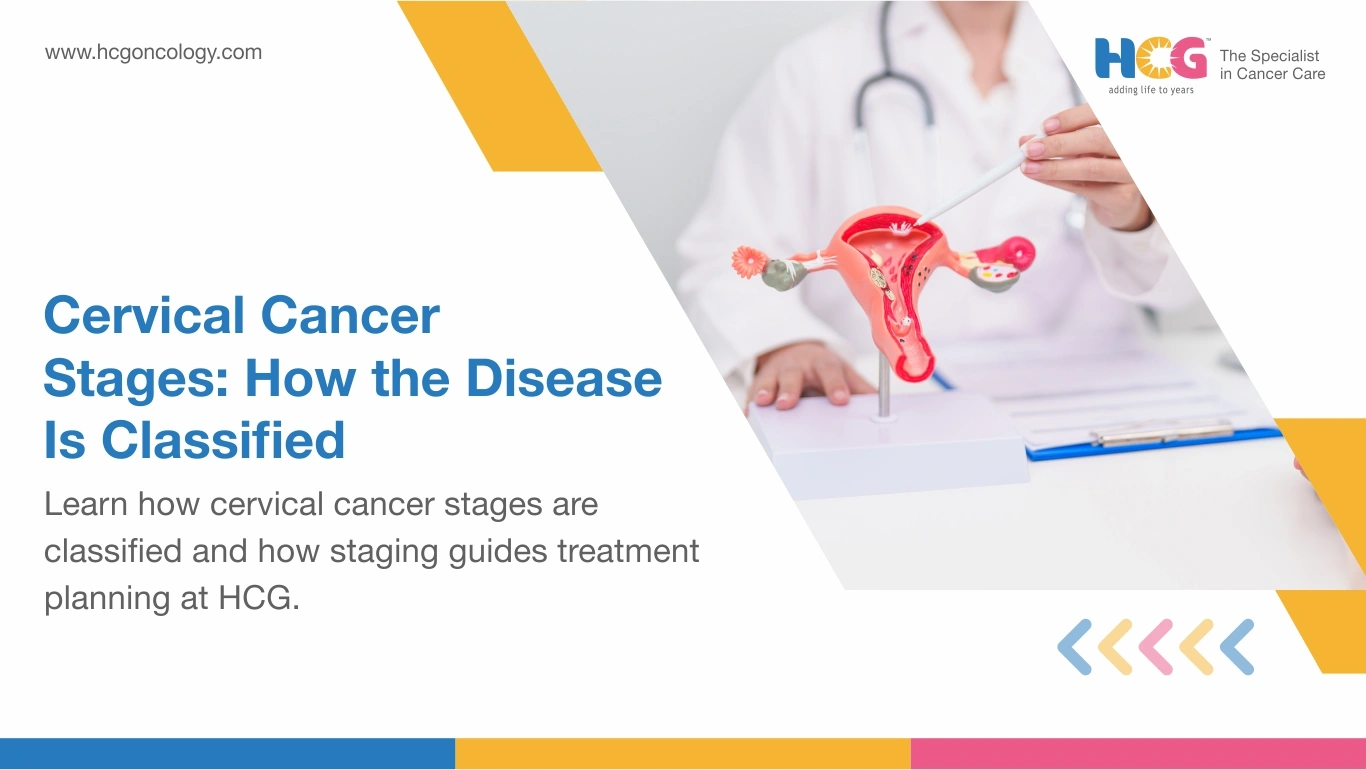
After a cervical cancer diagnosis, the first big question is how far things have spread. Staging answers that. Doctors use the FIGO system, built by the International Federation of Gynecology and Obstetrics, to classify the disease into four stages based on tumor size, invasion depth, and whether lymph nodes or distant organs are involved. GLOBOCAN 2022 (IARC/WHO) counted roughly 662,000 new cases globally that year, making cervical cancer the fourth most common cancer in women. In India, it ranks second among women. Your stage drives nearly every treatment decision, so understanding it matters.
FIGO stands for the International Federation of Gynecology and Obstetrics. Their system has been the global standard for decades, though a 2018 overhaul and 2024 tweaks sharpened it.
The big 2018 change? Imaging and pathology now formally count toward staging. Before that, only physical exam findings could set the stage. If an MRI spotted involved lymph nodes, it had no official staging role. Now it does.
Good to know: Parametrium is connective tissue around the uterus; its involvement defines Stage II B. Lymph nodes are small immune filters throughout the body; their involvement triggers Stage III C.
Three questions drive staging. How big and deep is the tumor? Has it reached neighboring structures? Are lymph nodes or distant organs involved?
No single test does it. Several pieces get fitted together.
A pelvic exam gauges tumor size. MRI gives close-up detail; CT or PET scans show the wider picture. Biopsy pins down cancer type and invasion depth. If Stage IV is a concern, cystoscopy or proctoscopy checks for bladder or rectal involvement.
| Stage | What It Means | Typical Treatment |
|---|---|---|
| Stage I | Within the cervix | Surgery, sometimes radiation after |
| Stage II | Past cervix, not pelvic wall | Surgery or chemoradiation |
| Stage III | Pelvic wall, lower vagina, or nodes | Chemoradiation |
| Stage IIIC | Lymph nodes involved | Chemoradiation |
| Stage IVA | Bladder or rectum | Chemoradiation in select cases |
| Stage IVB | Distant organs | Systemic therapy, palliative care |
Cancer has not crossed outside the cervix. But Stage I spans a wide range, from microscopic cells to visible tumors.
Stage IA is microscopic. IA1 means no deeper than 3 millimeters. IA2 means 3 to 5 millimeters. These often turn up after routine Pap smears. IA1 may need only conization.
Stage IB is visible or deeper than IA. IB1 is 2 centimeters or under. IB2 is 2 to 4 centimeters. IB3 is over 4.
Quick note: Size matters here more than you might expect. Small IB1 tumors often need surgery alone. IB3 might need chemoradiation instead. The team weighs everything before deciding.
Cancer has moved beyond the cervix but has not reached the pelvic wall or lower vagina.
Stage IIA means spread into the upper vagina. IIA1 is under 4 centimeters; IIA2 is 4 or bigger. Surgery works for IIA1. IIA2 usually shifts to chemoradiation.
Stage IIB means the parametrium is involved. That changes everything. Surgery steps aside, and chemoradiation takes over.
Locally advanced disease that has not jumped to distant organs.
Stage IIIA means the lower vagina is involved but not the pelvic wall. Stage IIIB means the pelvic wall is reached, or ureters are blocked enough to affect kidney function. That blockage sometimes shows on imaging before patients feel anything, which is why scans matter so much.
Stage IIIC, new in 2018, covers lymph node involvement. IIIC1 is pelvic nodes. IIIC2 is para-aortic nodes alongside the main abdominal artery.
Good to know: An “r” after the substage means imaging caught it. A “p” means tissue confirmed it. Same stage either way, just different detection paths.
Chemoradiation, chemotherapy and radiation together, is standard across Stage III.
Two different pictures here.
Stage IVA means cancer has pushed into the bladder or rectum. Chemoradiation can still work in some cases.
Stage IVB means spread beyond the pelvis to lungs, liver, bones, or distant nodes. Systemic treatment alongside palliative care is the path. And palliative care is not giving up. It protects quality of life while disease is actively treated.
Every Stage IV plan is built around the person, their health, where the cancer landed, and what they want from treatment.
Quick note: Palliative care and active treatment are not opposites. They work together. Palliative care manages symptoms and supports quality of life while the cancer itself is being treated.
Stage drives the plan but is not the only factor. Tumor type, general health, and fertility goals all weigh in.
For early-stage patients, especially IA or small IB1, trachelectomy (removing the cervix, keeping the uterus) might be possible. But that conversation has to happen before treatment starts. Once the uterus is gone, so is the option.
From IIB onward, chemoradiation leads. Knowing your substage helps you follow your team’s reasoning.
FIGO staging gives doctors and patients a shared language for treatment decisions. Stage I and Stage IV look nothing alike, but both come with a plan and a team.
At HCG, cervical cancer care runs on a multidisciplinary, evidence-based model. Specialists across medical, surgical, and radiation oncology collaborate through the National Tumor Board, keeping the patient and family at the center of every decision.
If you have been staged, talking it through with a specialist team is a solid next step. Keep these in mind:
Staging opens the door. Treatment planning walks through it.
Disclaimer: This information is intended to educate patients and caregivers. It does not replace professional medical advice. All treatment decisions should be made in consultation with a qualified doctor.
- American Cancer Society | Cervical Cancer Stages | https://www.cancer.org/cancer/types/cervical-cancer/detection-diagnosis-staging/staged.html
- Medical News Today | FIGO Staging for Cervical Cancer | https://www.medicalnewstoday.com/articles/cervical-cancer-figo-staging
- NCI | Cervical Cancer Treatment (PDQ) | https://www.cancer.gov/types/cervical/hp/cervical-treatment-pdq
- NCI | Cervical Cancer Stages | https://www.cancer.gov/types/cervical/stages
- NCI | Cervical Cancer Treatment by Stage | https://www.cancer.gov/types/cervical/treatment/by-stage
- PMC/NCBI | Implications of the Revised Cervical Cancer FIGO Staging System | https://pmc.ncbi.nlm.nih.gov/articles/PMC9131753/
- NCBI Bookshelf | Cervical Cancer (StatPearls) | https://www.ncbi.nlm.nih.gov/books/NBK431093/
- GLOBOCAN 2022 (IARC/WHO) | Cervix Uteri Fact Sheet | https://gco.iarc.who.int/media/globocan/factsheets/cancers/23-cervix-uteri-fact-sheet.pdf