07 Apr, 2026
Feel free to reach out to us.
07 Apr, 2026
So your doctor has recommended a mammogram, and now you want to know what the bill looks like. Fair enough. At comprehensive cancer hospitals like HCG, a standard screening mammogram can cost anywhere between ₹1,600 and ₹12,700, depending on the type of mammogram, the city, and whether you need a routine screen or detailed diagnostic imaging. 3D mammography sits at the higher end.
At Government hospitals, you can get this test for a significantly lower price, and some screening camps offer it free of charge. Breast cancer is the most commonly diagnosed cancer among Indian women, making up close to 27% of all female cancers per GLOBOCAN 2022 (IARC/WHO). Catching it early through regular mammography screening gives you more options and simpler care.
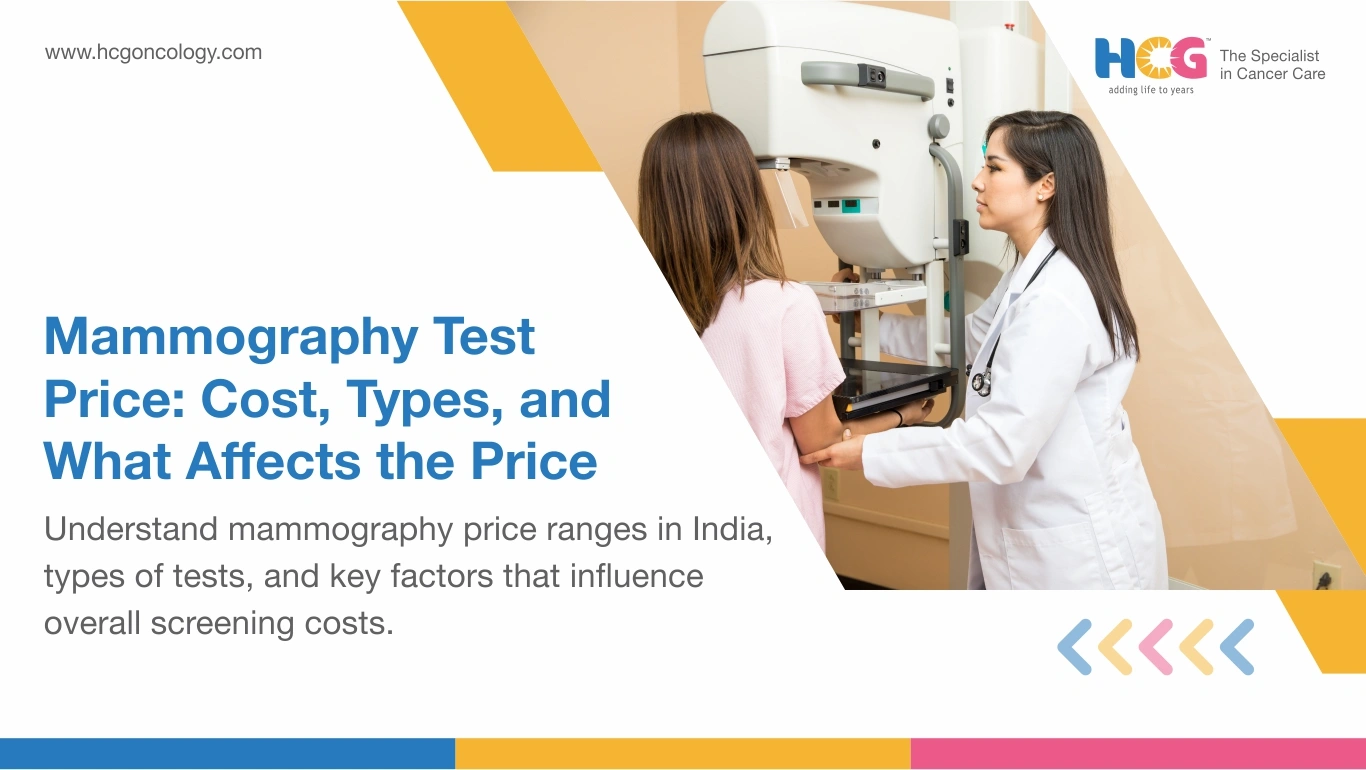
Think of it as a specialized X-ray for the breast. A mammogram uses a low dose of radiation to create detailed pictures of breast tissue. Radiologists examine those images for lumps, unusual calcifications, or tissue changes impossible to feel during a physical exam. The National Cancer Institute notes that mammography can pick up tumors well before they grow large enough to notice by touch.
Two types show up on most bills. A screening mammogram is the routine version for women with no symptoms. A diagnostic mammogram gets ordered when something needs a closer look, maybe a lump, nipple discharge, or a spot flagged on a previous screen. Diagnostic imaging requires more angles and more time, so it costs more.
Prices can vary depending on where you go and what your doctor orders. Here is a rough breakdown.
| Test Type | What It Does | Approximate Cost (Private Hospital) |
|---|---|---|
| Standard screening mammogram (unilateral) | Single breast, routine imaging | ₹1,600 – ₹6,600 |
| Standard screening mammogram (bilateral) | Both breasts, routine imaging | ₹2,200 – ₹12,700 |
| Diagnostic mammogram | Detailed imaging for symptoms or flagged findings | ₹2,500 – ₹13,100 |
| Mammogram + ultrasound (if advised) | Combined imaging, often for dense breasts | ₹2,900 – ₹6,600 |
| Screening Option | What You Get | Approximate Range |
|---|---|---|
| Screening mammogram – unilateral | Single breast, routine imaging | ₹1,600 – ₹6,600 |
| Screening mammogram – bilateral | Both breasts, routine imaging | ₹2,500 – ₹13,100 |
| Mammogram + ultrasound (if advised) | Combined imaging, often for dense breasts | ₹2,900 – ₹6,600 |
| Guided FNAC | Fine needle aspiration under mammography guidance | ₹2,230 – ₹5,090 |
| Guided biopsy | Tissue sample under mammography guidance | ₹5,760 – ₹13,100 |
| Wire localization | Pre-surgical marking of lesion | ₹6,800 – ₹15,500 |
Quick note: These are ballpark figures. Even two labs in the same city can charge differently. Always confirm before you show up.
Not every mammogram bill looks the same, and there are real reasons for that.
The Facility: A large accredited hospital chain will almost always charge more than a standalone diagnostic center. NABL-accredited labs tend to be pricier too, though you are paying for stricter quality control on imaging and reporting.
Worth knowing: NABL accreditation means the lab meets national standards for testing quality. The slightly higher price reflects more reliable imaging and reporting, which matters when the whole point is catching something early.
The Test Procedure: A basic 2D screening mammogram is the most affordable option. 3D tomosynthesis costs more because the machine captures layered images for a more detailed view. If your doctor orders diagnostic imaging with additional views, expect the bill to reflect that.
The City Where the Hospital Is: Mumbai, Delhi, and Bengaluru tend to charge more than smaller cities. A mammogram in a Tier 2 town might cost half of what you would pay in a metro.
Ward Category: The mammogram cost can also vary depending on whether you are an outpatient, in a general ward, or in a private room.
Radiologist's Interpretation Fees: Some labs/hospitals include it in the scanning costs, while others bill it separately.
Sometimes, yes. Some health insurance plans and corporate wellness packages include mammography under preventive screening. The catch is that insurers often draw a line between “routine screening” and “diagnostic test after a symptom,” with different coverage rules for each.
PM-JAY (Ayushman Bharat) may cover breast screening at empanelled hospitals for women who qualify. One phone call to your insurer before booking saves you the guesswork.
Good to know: Even if your plan does not cover screening mammography, it may cover a diagnostic mammogram if your doctor documents a clinical reason. Ask your insurer about the distinction before assuming it is not covered.
Most major medical bodies agree: average-risk women should start regular mammography screening around age 40. The USPSTF updated its guidance in 2024, now recommending biennial (every two years) screening mammograms from age 40 through 74.
That timeline shifts if you carry certain risk factors. A strong family history, BRCA1 or BRCA2 mutations, or prior chest radiation therapy may mean starting earlier or adding MRI to the mix. Your doctor is the best person to map out what works for you.
A radiologist reviews the images and puts together a report, usually ready within a few days. If everything checks out, you continue with routine screening at the regular interval.
If something needs a closer look, your doctor may suggest an ultrasound, a repeat mammogram with different angles, or occasionally a biopsy. An abnormal finding is a starting point for evaluation, not a diagnosis on its own.
What this means in practice: An abnormal mammogram result does not mean you have cancer. It means something needs a clearer look. The next step is usually straightforward, and your doctor will walk you through it.
When decisions about breast screening feel uncertain, HCG Cancer Hospital helps by taking an evidence-based, patient-first approach. The care team works with each person to figure out the right test, the right timing, and a follow-up plan that fits their health picture.
If a mammogram has been sitting on your to-do list because of cost questions or scheduling confusion, reaching out to a specialist can untangle most of that. No question about breast screening is too small. And early, regular mammography remains one of the most straightforward things you can do for your breast health.
Disclaimer: This information is intended to educate patients and caregivers. It does not replace professional medical advice. All treatment decisions should be made in consultation with a qualified doctor.
- NCI (cancer.gov) | Mammograms | https://www.cancer.gov/types/breast/screening/mammograms
- NCI (cancer.gov) | Breast Cancer Screening | https://www.cancer.gov/types/breast/patient/breast-screening-pdq
- GLOBOCAN 2022 / IARC | Global Cancer Statistics 2022 | https://acsjournals.onlinelibrary.wiley.com/doi/10.3322/caac.21834
- USPSTF | Screening for Breast Cancer: Recommendation Statement (2024) | https://jamanetwork.com/journals/jama/fullarticle/2818283
- PMC | Screening for Breast Cancer: A Comparative Review of Guidelines | https://pmc.ncbi.nlm.nih.gov/articles/PMC11204612/
- PMC | Cancer Incidence Estimates for 2022 & Projection for 2025: NCRP India | https://pmc.ncbi.nlm.nih.gov/articles/PMC10231735/
- RadiologyInfo.org / ACR-RSNA | Breast Cancer Screening | https://www.radiologyinfo.org/en/info/screening-breast
- JCO Global Oncology | Comprehensive Overview of Breast Cancer in India | https://ascopubs.org/doi/10.1200/GO-25-00083