01 Apr, 2026
Feel free to reach out to us.
01 Apr, 2026
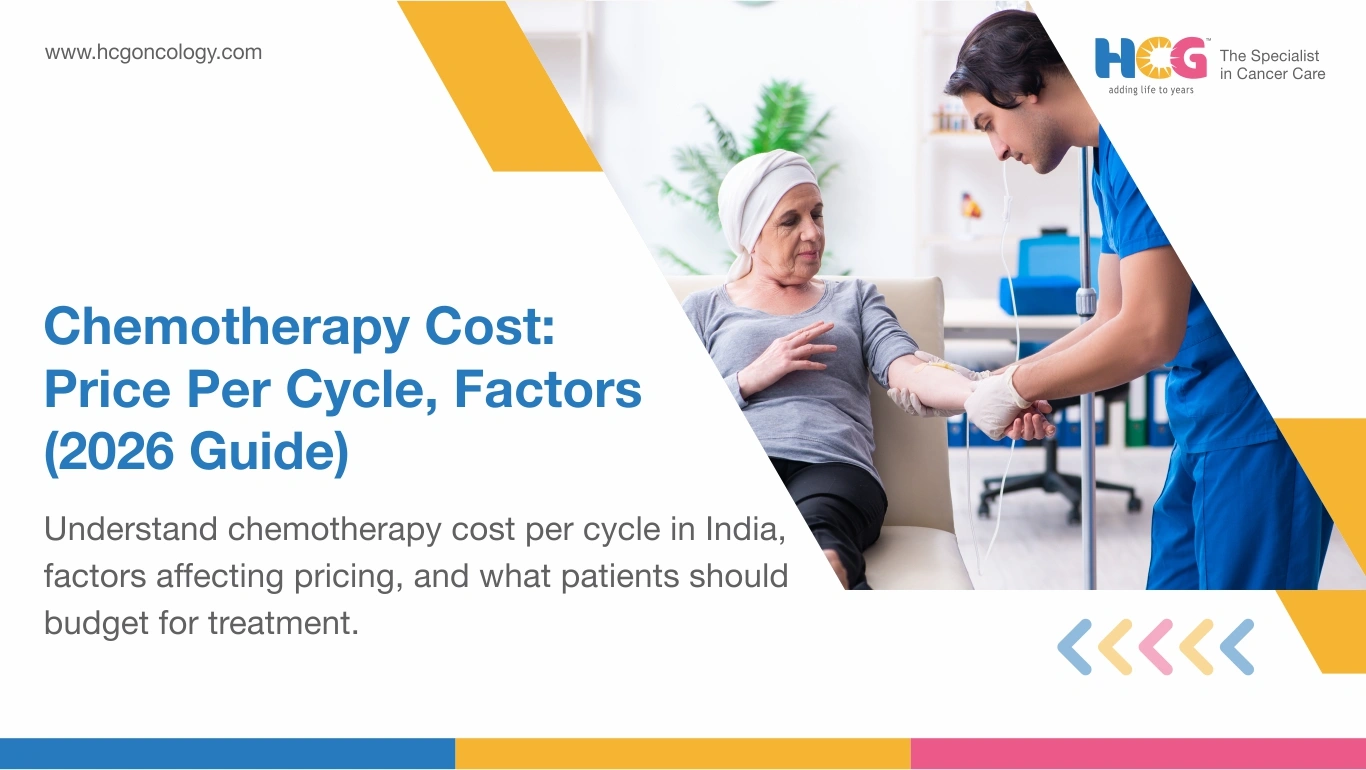
A single chemotherapy cycle in India costs anywhere between ₹8,000 and ₹2,00,000. Total treatment across all cycles usually falls between ₹2.5 lakh and ₹25 lakh for most patients.
You may wonder why there is such a wide range.
A breast cancer patient on AC-T and a lymphoma patient on R-CHOP are not taking the same drugs, sitting in the infusion chair the same number of times, or walking into the same type of hospital. Each of those variables shifts the final number. Getting a handle on them before cycle one starts makes the financial side far less overwhelming.
One cycle runs between ₹8,000 and ₹2,00,000. Breast and colorectal cancer regimens usually sit in the ₹15,000 to ₹50,000 band. Introduce a targeted biologic, and that figure climbs quickly.
Good to know: Whatever drug price you are quoted, that number is not your session total. Infusion suite time, IV fluids, anti-nausea injections, and nursing charges are added on top, every visit.
Cycle schedules typically repeat every 2 to 4 weeks. Most full courses involve 4 to 8 cycles. Oral tablets like capecitabine appear cheaper per dose, but they run for months. By the end, the cumulative spend often matches what an IV regimen would have cost.
Per-cycle cost by regimen:
| Regimen | Cancer Type | Estimated Per Cycle |
|---|---|---|
| AC-T | Breast | ₹20,000 to ₹60,000 |
| FOLFOX / CAPOX | Colorectal | ₹15,000 to ₹50,000 |
| R-CHOP | Lymphoma | ₹30,000 to ₹80,000 |
| Carboplatin + Paclitaxel | Lung / Ovarian | ₹25,000 to ₹70,000 |
| ABVD | Hodgkin Lymphoma | ₹15,000 to ₹45,000 |
Costs vary by hospital and patient profile.
Metro hospitals charge more. Higher land costs, bigger operational teams, and brand positioning all feed into that gap. Clinical outcomes, though, are not always proportionally better.
| City | Approx. Per Cycle | Notes |
|---|---|---|
| Bengaluru | ₹15,000 to ₹80,000 | tertiary center premium |
| Mumbai | ₹20,000 to ₹1,00,000 | Highest urban rates |
| Chennai | ₹12,000 to ₹75,000 | Competitive pricing |
| Hyderabad | ₹10,000 to ₹70,000 | Growing oncology hub |
| Ahmedabad | ₹8,000 to ₹55,000 | Tier 2 city rates |
A capable Tier 2 hospital running the same protocol can cost 20 to 30 percent less than a metro equivalent. Where you get treated and how well you get treated are two separate questions.
Note:Per-cycle costs may even go up to ₹2,00,000-₹3,00,000, depending on various factors.
Start with the drugs. Conventional cytotoxic agents like cyclophosphamide or 5-fluorouracil are, by oncology standards, reasonably affordable. Monoclonal antibodies are an entirely different category. Rituximab, trastuzumab, and bevacizumab are not synthesized chemicals they are living proteins grown through biological manufacturing. That production complexity is reflected in every invoice.
Past the drug itself, five things determine what treatment actually costs:
Common confusion: A drug cost estimate and a full treatment cost estimate are not the same document. Always ask your hospital for an itemized breakdown that includes support medications before agreeing to start.
Most standard health insurance policies cover inpatient chemotherapy. Coverage for day-care infusions has become more widely available under updated IRDAI guidelines, though individual policy terms vary considerably.
PM-JAY covers approved chemotherapy regimens at empaneled hospitals across India. The NTR Vaidya Seva scheme in Andhra Pradesh goes further, offering cashless treatment up to ₹25 lakh per family per year, covering the patient from registration through 10 days after discharge.
With private policies, three questions need clear answers before treatment begins: whether day-care infusions fall within your coverage, whether your plan carries an oncology sub-limit, and whether pre-authorization is required separately for each cycle.
Good to know: A verbal rejection from an insurer carries little weight. Request any refusal in writing. That written denial opens a formal appeal process, and many families find the outcome reverses.
Treatment costs do not end at the infusion suite door. Blood count monitoring, imaging scans every two to three cycles, dietary support, and physiotherapy each carry their own charges. Patients who skip follow-up tests to save money often spend far more managing the complications those tests would have caught. Neutropenia identified in a routine blood draw costs a fraction of the hospitalization it prevents.
With oral chemotherapy, consistency matters just as much. Skip one cycle and the drug's cumulative effect breaks down. Restarting an interrupted protocol carries clinical risk and restarts costs that were already partially sunk.
When decisions need to be made, HCG helps by treating the financial side of cancer care with the same seriousness as the clinical side. HCG Cancer Hospital coordinates insurance pre-authorization, connects patients with government schemes, and runs the HCG Foundation's financial aid program, which has helped thousands of patients access subsidized or fully covered treatment since 2006. Chemotherapy cost is rarely fixed and almost always negotiable when raised early. The families who struggle most are the ones who stay quiet about money until a cycle gets missed.
Disclaimer:This information is intended to educate patients and caregivers. It does not replace professional medical advice. All treatment decisions should be made in consultation with a qualified doctor.