01 Apr, 2026
Feel free to reach out to us.
01 Apr, 2026
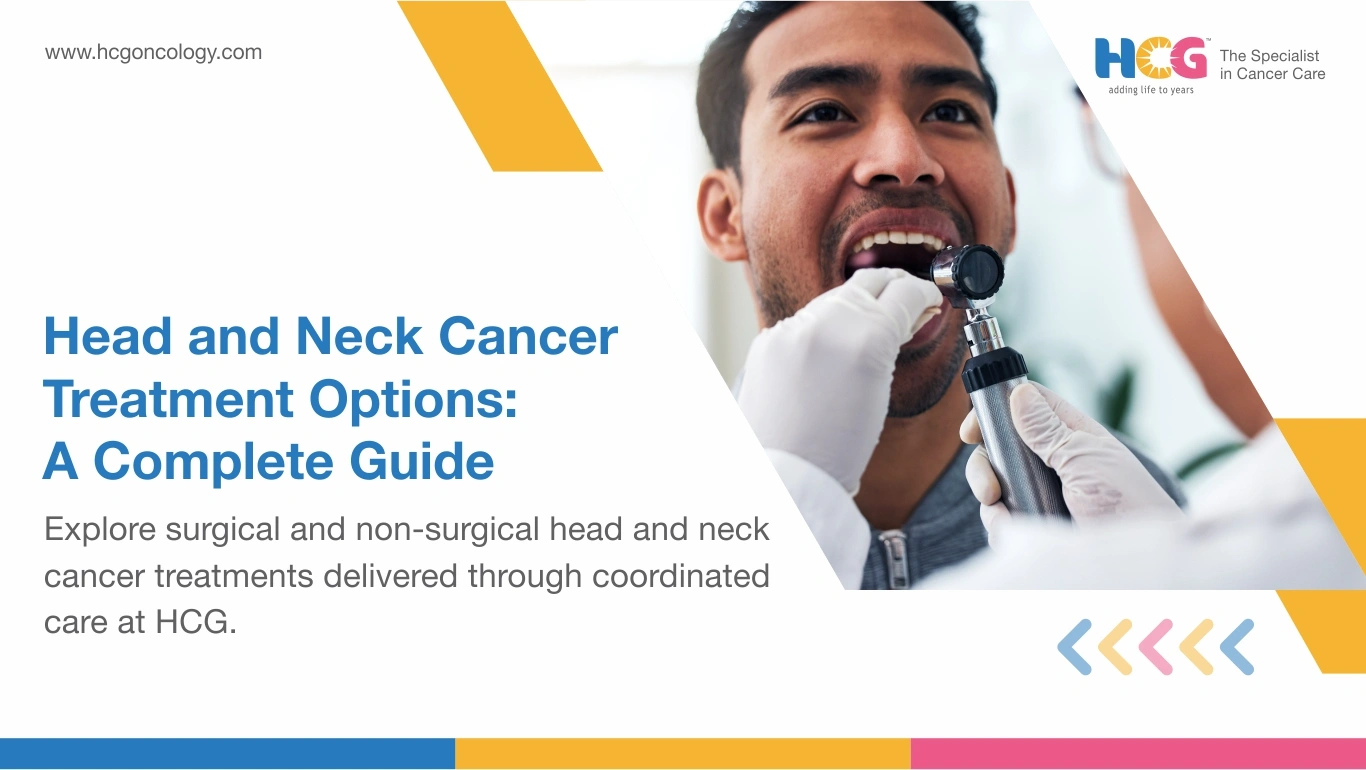
If you or someone you care about has been diagnosed with head and neck cancer, the treatment terms can feel overwhelming. Head and neck cancer is actually a group of cancers, not one disease. They can start in the mouth, throat, voice box (larynx), nasal passages, or salivary glands. GLOBOCAN 2022 data from the IARC/WHO puts the global count at around 940,000 new cases a year, ranking these cancers seventh worldwide. Head and neck cancer treatments range from surgery and radiation to chemotherapy, targeted drugs, and immunotherapy, and most people need more than one. What makes these cancers tricky is their location: they grow near the parts of your body you use to talk, eat, and breathe.
Because these cancers behave differently depending on where they start, there is no single playbook.
Before anything starts, a team of specialists sits down together: a surgeon, a radiation oncologist, a medical oncologist, a speech therapist, and a dietitian. They look at the full picture and build a plan around both the cancer and the person living with it.
For many head and neck cancers, especially oral cavity tumors caught early, surgery is the first step. The aim: remove the cancer with a rim of healthy tissue (clear margins) while disturbing as little as possible.
Main types you might hear about:
Quick note: If a large area needs removal, the surgeon may rebuild it in the same operation using tissue from elsewhere in the body (free flap reconstruction).
Radiation targets cancer cells with high-energy beams. It might be the main treatment, a follow-up after surgery, or delivered alongside chemo.
One technique you will hear about is IMRT (intensity-modulated radiation therapy). It sculpts the beam to hug the tumor tightly. In everyday terms, the cancer gets a strong dose, while nearby salivary glands, the spinal cord, and swallowing muscles get better protection.
Side effects include dry mouth (xerostomia), mouth soreness, skin irritation, and trouble swallowing. A dental check before radiation is something your team will insist on, because radiation can weaken the jawbone.
For nasopharyngeal cancer, radiation is almost always the lead treatment, sometimes with chemo alongside.
On its own, chemo is rarely the main weapon here. Its real value is in chemoradiation: chemo drugs run at the same time as radiation, making tumor cells more vulnerable.
Bottom line: Think of chemo less as an independent fighter and more as something that turns up the volume on radiation.
Doctors sometimes use induction chemotherapy first, shrinking the tumor before primary treatment. Other times chemo follows surgery when warning signs appear, like cancer at the tissue edges or spread to several lymph nodes.
Targeted therapy goes after specific molecules cancer cells need. Many head and neck tumors overproduce a protein called EGFR. Cetuximab latches onto EGFR and blocks it and may be used alongside radiation or chemo in the right scenario.
Immunotherapy works differently. Pembrolizumab and nivolumab are PD-1 inhibitors that take the brakes off your immune system so it can fight the cancer. These tend to be used when cancer has returned or spread.
Where the tumor sits changes everything. Here is a practical breakdown:
| Cancer Site | Primary Treatment Approach | Organ-Preservation Note |
|---|---|---|
| Oral cavity | Surgery, often followed by radiation if risk factors exist | Preservation limited; surgery is usually the go-to |
| Oropharynx | Chemoradiation or surgery (TORS in select cases) | Preservation often possible, especially HPV-positive |
| Larynx | Chemoradiation for advanced; surgery for early or resistant | Voice-box preservation achievable in selected patients |
| Nasopharynx | Radiation with concurrent chemo | Surgery rarely leads; radiation handles most cases |
| Hypopharynx | Chemoradiation or surgery based on stage | Preservation may be tried; success depends on the stage. |
The real takeaway: stage matters enormously. An early cancer and a locally advanced one may need completely different strategies.
Surgery versus chemoradiation at a glance:
| Feature | Surgery | Chemoradiation |
|---|---|---|
| Best suited for | Early-stage, oral cavity tumors | Locally advanced, organ preservation |
| Effect on function | Depends on how much tissue is removed | Can cause mouth soreness, dry mouth |
| Voice impact | Total laryngectomy permanently changes voice | Often preserves voice in laryngeal cancers |
| Preferred when | Clear margins achievable without major function loss | Avoiding surgery protects a critical structure |
This is one of the biggest concerns patients raise. Organ-preservation therapy is the clinical term for plans built to avoid removing the larynx or other structures tied to speech and swallowing.
For cancers of the larynx and throat, chemoradiation has controlled the disease while keeping these functions intact in a good number of patients. TORS offers a similar benefit for certain throat tumors.
Good to know: Rehab should not wait until treatment finishes. Starting speech and swallowing exercises early genuinely helps long-term recovery.
Treatment options today are broader and more precise than a decade ago. Radiation hits with less collateral damage. Function-sparing strategies keep more patients talking and eating. Newer drugs offer meaningful paths when cancer returns.
HCG Cancer Hospital brings together surgical oncologists, radiation specialists, and medical oncologists to evaluate each case as a team. The priority is getting the right treatment the first time while keeping quality of life front and center.
If a head and neck cancer diagnosis has come your way, a specialist team is the clearest next step. A consultation at HCG can help you understand where things stand and what makes sense moving forward.
Disclaimer: This information is intended to educate patients and caregivers. It does not replace professional medical advice. All treatment decisions should be made in consultation with a qualified doctor.
- NCI (cancer.gov) | Head and Neck Cancers Fact Sheet | https://www.cancer.gov/types/head-and-neck/head-neck-fact-sheet
- NCCN (nccn.org) | NCCN Guidelines Head and Neck Cancers | https://www.nccn.org/guidelines/guidelines-detail?id=1437
- JNCCN | NCCN Guidelines Insights: Head and Neck Cancers, Version 2.2025 | https://jnccn.org/view/journals/jnccn/23/2/article-p2.xml
- PMC (NIH) | An Updated Review on Head and Neck Cancer Treatment with Radiation Therapy | https://pmc.ncbi.nlm.nih.gov/articles/PMC8508236/
- PMC (NIH) | Global burden of head and neck cancer: Epidemiological transitions and projections to 2050 | https://pmc.ncbi.nlm.nih.gov/articles/PMC12507627/
- NCI (cancer.gov) | Cetuximab Outperforms Durvalumab for Head and Neck Cancer | https://www.cancer.gov/news-events/cancer-currents-blog/2024/head-neck-cancer-cetuximab-versus-durvalumab
- Wiley MedComm | Head and neck cancer: pathogenesis and targeted therapy (2024) | https://onlinelibrary.wiley.com/doi/10.1002/mco2.702
- PubMed | GLOBOCAN 2022 Global Cancer Statistics | https://pubmed.ncbi.nlm.nih.gov/38572751/