30 Apr, 2026
30 Apr, 2026
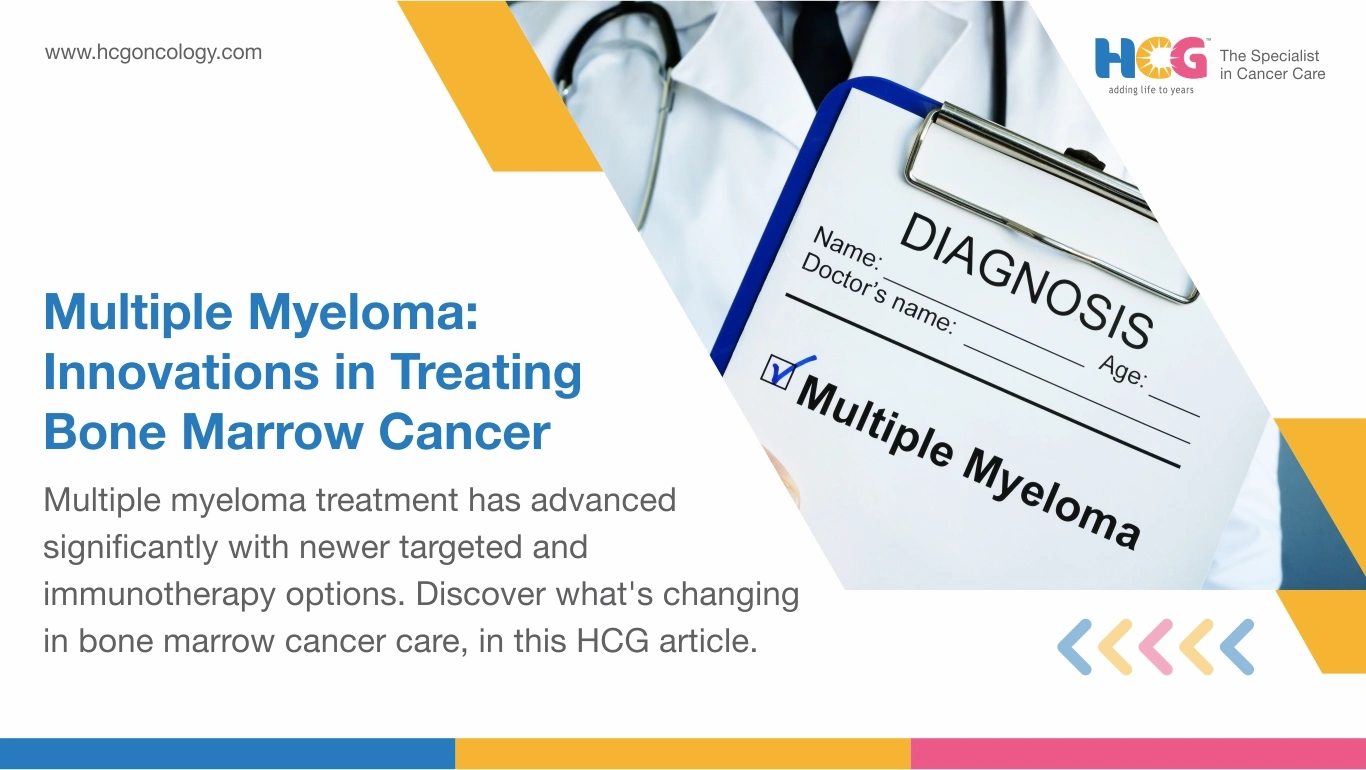
Multiple myeloma treatment has changed fundamentally. This cancer takes hold when plasma cells in the bone marrow multiply without control, crowding out healthy blood cells and eroding bone from within. Most patients live with vague symptoms for months before a diagnosis is made. With proteasome inhibitors, monoclonal antibodies, and stem cell transplant protocols now available, multiple myeloma has shifted from a near-certain fatal diagnosis to a condition many patients manage for years.
| CRAB Component | Clinical Meaning | What the Patient Feels |
|---|---|---|
| C: Calcium (hypercalcemia) | Excess calcium from dissolving bone | Nausea, confusion, excessive thirst |
| R: Renal Impairment | Kidney stress from M-protein and light chains | Reduced urine output, fatigue |
| A: Anemia | Low red cell count from marrow crowding | Bone-deep tiredness, breathlessness |
| B: Bone lesions (osteolytic) | Localized holes dissolved in the bone structure | Deep aching in the back, ribs, or hips |
Identifying which CRAB components are active determines both treatment urgency and protocol selection.
Bone pain is the most frequent first signal. Other symptoms include:
A deep, persistent ache in the back, ribs, or hips that worsens with movement and does not settle with rest. This reflects osteolytic lesions where malignant plasma cells have dissolved normal bone architecture from within.
Unexplained fatigue and recurrent infections follow closely. Myeloma suppresses functional immunoglobulins, creating immunoparesis: a state where the immune system appears intact but is structurally compromised, as per Cancer Research UK reports.
These symptoms do not confirm multiple myeloma. Serum protein electrophoresis and a hematologist's assessment are the only reliable ways to establish a clinical diagnosis.
Multiple myeloma arises from plasma cells, the antibody-producing B cells residing in the bone marrow. Leukemia originates from early white blood cell precursors. Treatment protocols, drug classes, and transplantation roles differ substantially between the two.
Both cause anemia and marrow dysfunction. The monitoring markers, specifically M-protein and Bence-Jones protein for myeloma, are disease-specific and not interchangeable with leukemia markers.
Survival has improved meaningfully with modern treatment combinations.
According to a 2025 report from the European Society of Medicine, Indian tertiary care data now report one-year overall survival rates above 95% in newly diagnosed patients, with five-year outcomes improving significantly for those achieving MRD-negative remission post-transplant.
Cytogenetic risk stratification guides maintenance intensity. Consult your hematologist for a stage-specific outlook, as survival varies by subtype and treatment center.
Multiple myeloma treatment follows a risk-stratified, sequential protocol. Induction therapy combines proteasome inhibitors such as bortezomib with IMiDs like lenalidomide or thalidomide and corticosteroids. For eligible patients, an autologous stem cell transplant follows: the patient's own stem cells are harvested before high-dose melphalan conditioning and then reinfused to reconstitute the bone marrow
Our senior hemato-oncologists at HCG Cancer Hospital assess transplant eligibility through the multidisciplinary tumor board. Patients not eligible to receive combination therapy, including anti-CD38 monoclonal antibodies such as daratumumab.
Maintenance therapy with lenalidomide following transplant has demonstrated a meaningful extension of progression-free survival (per Cancer Research UK). CAR T-cell therapy, available at HCG's Kolkata and Jaipur centers, is applied in relapsed or refractory myeloma where earlier lines have been exhausted (per the American Cancer Society).
MRD-negative remission means minimal residual disease is undetectable. Reaching this threshold correlates strongly with longer survival intervals.
Diagnosis begins with serum protein electrophoresis to detect abnormal M-protein. Urine Bence-Jones protein testing identifies light chain secretion. A bone marrow biopsy, where cellular material is extracted from the iliac crest under local anesthesia, provides a confirmatory histopathological diagnosis and cytogenetic risk stratification. Whole-body low-dose CT or PET-CT maps osteolytic skeletal involvement before staging is finalized.
Think of it this way: blood identifies the protein, urine identifies the light chains, a biopsy identifies the cell, and imaging maps the damage.
Malignant plasma cells stimulate osteoclasts while suppressing osteoblasts, creating a one-directional destructive bone cycle (per PMC/NIH). Bisphosphonates such as zoledronic acid are now standard to reduce fractures and spinal cord compression (per MD Anderson Cancer Center). HCG integrates hematologic oncology with orthopedic oncology support so bone health is managed actively alongside systemic therapy.
The post-transplant phase involves neutropenic ward care, infection surveillance, and nutritional support through engraftment. Post-transplant pain is managed through multimodal analgesia protocols. Immune reconstitution and vaccination schedule restoration are standard milestones, typically completed within 12 to 24 months.
Long-term recovery includes M-protein monitoring, serum free light chain assays, and follow-up imaging. Psycho-oncology services at HCG extend to family members managing the chronic care burden. Bone rehabilitation supervised by physiotherapy restores functional mobility. Daycare chemotherapy units allow maintenance therapy without repeated hospitalization.
In summary, sustained follow-up is what makes long-term remission possible.
The answer depends on remission depth, maintenance adherence, and MRD monitoring regularity. Patients in MRD-negative remission following transplant often return to work and an active family life. Follow-up imaging and blood marker surveillance at three- to six-month intervals is the clinical infrastructure that makes this possible.
As a leading cancer hospital in India, HCG focuses on treating multiple myeloma as a long-term condition, not a single acute event. From induction chemotherapy through stem cell transplant, monoclonal antibody maintenance, and active bone health management, the pathway is continuous and individualized. HCG Cancer Hospital's Hemato-Oncology and BMT Department, led by senior hemato-oncologists across our national network, brings this full spectrum under one NABH-accredited roof.
Next Steps for Your Doctor Visit:
Disclaimer: This information is intended to educate patients and caregivers. It does not replace professional medical advice. All treatment decisions should be made in consultation with a qualified doctor.
Feel free to reach out to us.