Didn't find what you were looking for?

Feel free to reach out to us.

+91
Or reach us directly
Chat With Us
×

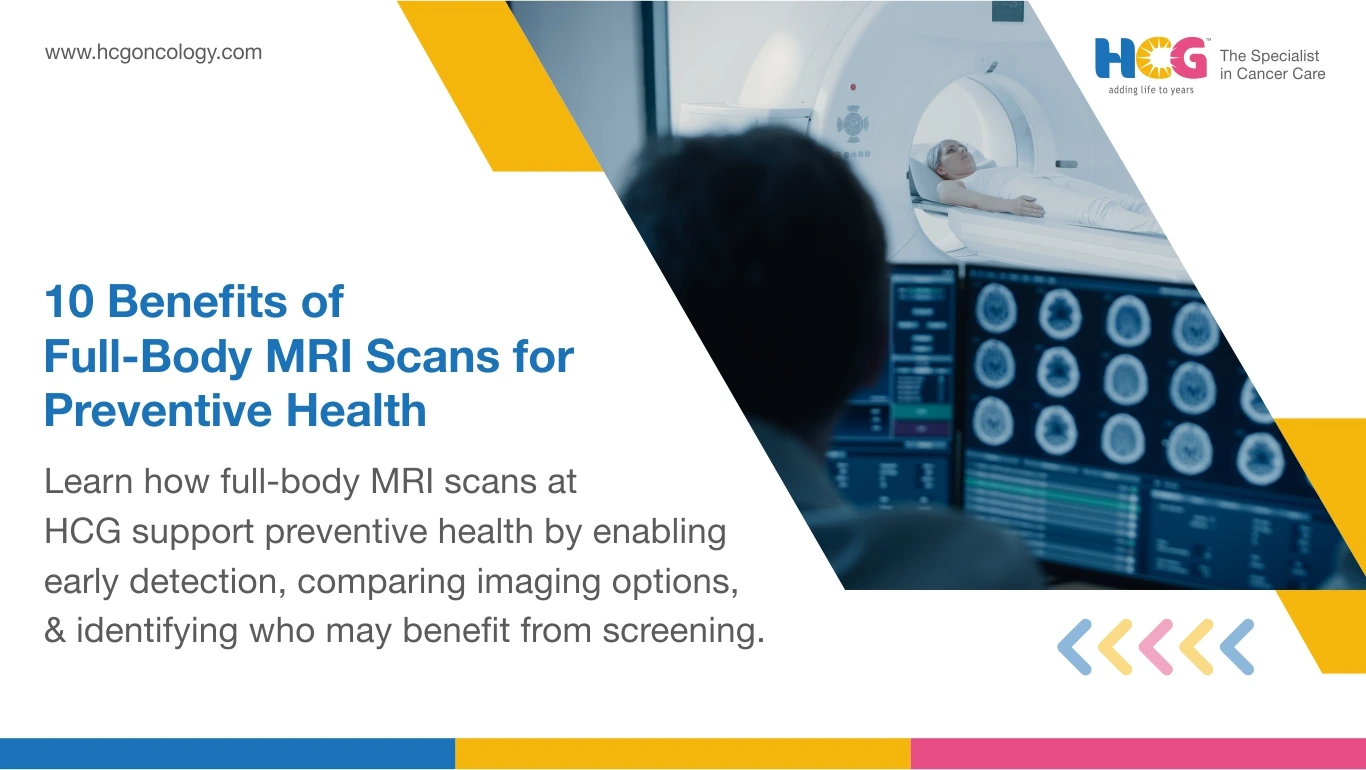
10 Benefits of Full-Body MRI Scans for Preventive Health

Full-body MRI scan for Preventive Health

13 Jan, 2026

Dr. Prabhu Nesargikar, Consultant - GI and Peritoneal Cancer & Robotic Surgery

This article is medically reviewed by Dr. Prabhu Nesargikar, Senior Consultant - GI and Peritoneal Cancer & Robotic Surgery, HCG Cancer Centre, K.R. Road, Bengaluru.

Table of Contents

Overview

Reports suggest that full-body MRI scans benefit about 68% of people in detecting clinically relevant diseases, like cancer, or incidental findings that require additional testing or follow-up in selected population groups.

Next comes the question, “What is an MRI scan?”

An MRI scan is a detailed imaging technique that uses strong magnetic fields and radio waves to examine major organs and tissues in the body.

Full-body MRI, or whole-body MRI, is a type of MRI scan that examines the entire body instead of a specific body part.

Also referred to as a radiation-free full-body scan, this imaging technique can be effective in identifying structural anomalies that may indicate a disease, even before it starts showing symptoms.

In this article, we learn about the various benefits of whole-body MRI scans, key differences between them and other scans, and who should consider undergoing this scan.

How Do Full-Body MRI Scans Benefit Preventive Health?

Learning the benefits of this imaging technique can help people make informed preventive health decisions for themselves and their loved ones.

The following are the key advantages of undergoing whole-body MRI scans as part of preventative health screening:

  1. 1. Early Cancer Detection
    It can detect potentially harmful tumors or cancerous lesions in their early or asymptomatic stages, when the disease is still localized and still treatable. This scan is especially helpful for those with inherited cancer risk.
  2. 2. No Radiation Risk Compared to CT Scans
    Unlike CT scans or X-rays, MRI scans do not use ionizing radiation; hence, they are safer for screening purposes. This is especially important for individuals who undergo regular screening for monitoring purposes.
  3. 3. Comprehensive Organ Screening
    A single whole-body MRI scan can visualize the brain, spinal cord, chest, belly, pelvis, and key joints and present a comprehensive picture of the health.
  4. 4. High-Details Soft Tissue Imaging
    MRI scans provide a more detailed view of muscles, ligaments, organs, and the nervous system than many standard scans by increasing soft tissue contrast. This improves the effectiveness of preventive health screening.
  5. 5. Detection of Silent (Asymptomatic) Conditions
    Many diseases do not cause any symptoms in the early stages and are often detected in the advanced stages when their treatment becomes challenging. Screening through whole-body MRI scans can help detect cancer, vascular diseases, and organ inflammation before they become serious.
  6. 6. Monitoring Chronic Conditions
    This scan can also help in monitoring existing health conditions and seeing if there are any interventions required.
  7. 7. Support for Preventive Decision-Making
    The insights from the whole-body MRI scans can help doctors look for health problems and recommend appropriate lifestyle modifications to reduce the risk of various medical conditions, including cancer.
  8. 8. Clarity, Confidence, and Peace of Mind About Health
    For some individuals, screening through whole-body MRI scans can provide reassurance about their health when combined with appropriate clinical assessment, while also encouraging them to prioritize their health.
  9. 9. Non-Invasive and Painless
    MRI scans are non-invasive and painless. However, it may cause slight discomfort, as patients are expected to remain still throughout the scan.
  10. 10. Minimal Post-Scan Side Effects
    MRI scans are generally well-tolerated, and patients do not experience any serious side effects.

What are the Key Differences Between Full-Body MRI and Other Scans?

While all imaging techniques aim to examine the internal structures, they do differ in terms of operation, specific purposes, duration, and other aspects. The following table elucidates the key differences between full-body MRIs and other scans:

Full-Body MRI Scan Other Imaging Scans (CT, Ultrasound, X-ray)
In a single scan, multiple organs are examined These procedures focus on a specific organ or area of concern
Involves magnetic fields and radio waves for image generation; no ionizing radiation is involved. CT and X-ray use radiation; ultrasound uses sound waves.
Generates high-detail images of soft tissues and organs Better suited for bones, lungs, or real-time surface imaging
Scan duration is typically 45–60 minutes Scan duration is generally shorter
Suitable for selected preventive health assessments Primarily used for symptom-based or targeted diagnosis
It has fewer post-scan side effects and does not involve radiation exposure. Some scans may involve contrast or radiation exposure.

Who Should Undergo a Full-Body MRI Scan?

This scan may be recommended for individuals with:

  1. 1. A strong family history of cancer
  2. 2. Known genetic cancer syndromes
  3. 3. Need for surveillance or monitoring based on previous alarming findings
  4. 4. Unexplained symptoms like neurological changes, persistent pain, and weight loss

It may also be recommended for all individuals aged 35 and over as part of a comprehensive health evaluation, depending on their lifestyle habits, medical history, and family history.

Get a Full-body MRI Scan at HCG Cancer Hospital, Bangalore

HCG Cancer Hospital, a centrally located cancer hospital in Bangalore (Bengaluru), offers comprehensive health screening through whole-body MRI scanning services.

The radiology department at HCG Bangalore employs the high-end 3 Tesla MRI platform to obtain high-resolution images of various critical structures inside the body. Each scan at HCG is clinically guided to make sure that each individual receives screening support that meets their specific needs.

The reports are carefully evaluated by experienced radiologists who provide prompt guidance on the steps and help patients make informed decisions for their health and well-being.

Related Pages

Frequently Asked Questions

It may show structural problems with the spine, blood vessels, soft tissues, and organs, such as tumors, inflammation, cysts, or degenerative changes. These scans help in identifying these anomalies even before they start showing symptoms.

It is usually safe because the MRI platform uses magnetic fields instead of radiation. However, it may be unsuitable for people with certain implants, metal devices, severe claustrophobia, and specific medical conditions

A quick internet search with terms like “full-body MRI scan in Bangalore” or “whole-body MRI scan near me” can help you find the nearest hospitals with this imaging facility.

It usually takes 45 to 90 minutes, including setting up and capturing images.

This time may vary depending on the method, the patient's movement, the amount of body covered, and the need for more sequences.

Typically, the cost of a full-body MRI scan in Bangalore ranges from ₹25,000 to ₹60,000, depending on the location, type of scanner, and depth of reporting.

At HCG Cancer Hospital in Bangalore, we are offering a full-body MRI scan at just ₹4,999/- until January 31st, 2026. Reach out to HCG Cancer Hospital for more information.

The frequency at which you may need a screening MRI scan depends on multiple factors, like age, family history, medical history, and risk factors. It may be recommended once every 1-2 years.

Yes, whole-body MRI for cancer screening can help find abnormal masses or lesions that could be cancerous. However, additional tests like biopsies, PET scans, or clinical exams may be recommended to confirm the findings.

Additionally, these reports should be reviewed by a specialist for a conclusive diagnosis.

Yes, whole-body MRI scans are safe for individuals aged 18 and above; as a screening procedure, it is recommended for individuals aged 35 and over.

References

Dr. Prabhu Nesargikar, Consultant - GI and Peritoneal Cancer & Robotic Surgery

About the Reviewer

Dr. Prabhu Nesargikar

Senior Consultant - GI and Peritoneal Cancer & Robotic Surgery
MBBS, MRCS (RCSEng), MA (Medical Education), MD (Research), MFSTEd (RCSEd), FRCS (RCSEd), CCT (UK)

Dr. Prabhu Nesargikar is a highly experienced surgical oncologist with expertise in gastrointestinal robotic surgery, surgical gastroenterology, and advanced endoscopic surgery. He is available for consultations at HCG Cancer Centre, KR Road, Bangalore. He specializes in the management of all major GI malignancies, namely esophageal cancer, stomach cancer, small intestine cancer, and colorectal cancer, along with peritoneal malignancies. He takes a holistic approach to treatment and is committed to providing the best possible care for his patients.

Appointment Link: Book an Appointment with Dr. Prabhu Nesargikar.

Other Blogs

Call Icon
WhatsApp Icon
Google Playstore Download logo
App Store Download logo