25 Aug, 2026
25 Aug, 2026
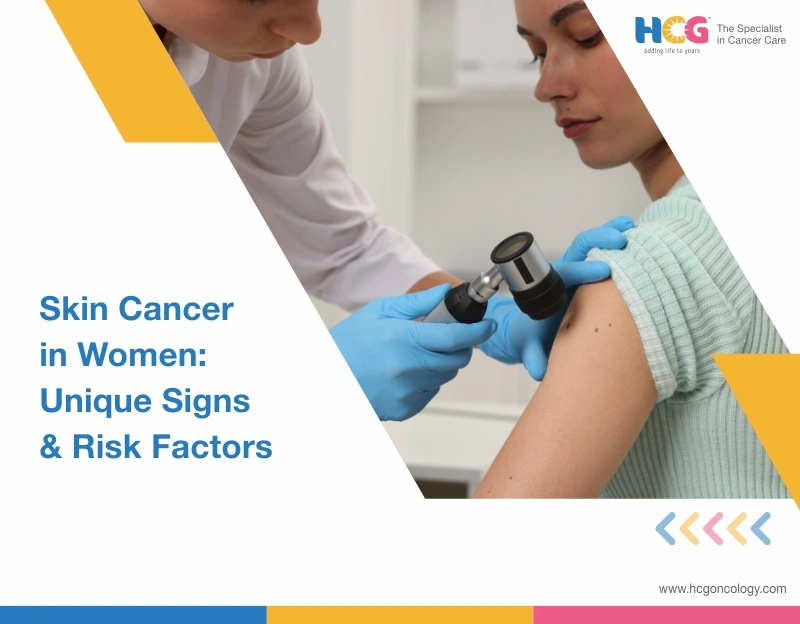
Many women find skin cancer when they notice a mole has changed or there’s a persistent sore. These things might seem small at first, but catching them early really boosts treatment success.
Learning about the signs of skin cancer in women from simple mole changes to melanoma symptoms can help with getting early diagnosis and care.
Signs of skin cancer in women often begin as subtle skin changes like new growths, mole changes, or non-healing sores. These signs are easy to ignore, especially when they appear gradually or without pain.
A sore that does not heal within four weeks is one of the most common signs of skin cancer. These lesions may bleed, scab, and reappear, often mistaken for minor skin issues.
A flat brown spot with uneven edges, a pearly bump near the hairline, or a sore that won't heal and that a skin cancer specialist would flag but most women wouldn't think twice about. What does skin cancer look like in women?
Can skin cancer look like a pimple?
These changes may be overlooked because they often develop gradually. Without ever realizing what's sitting underneath.
Dermatologic oncology teams lean on the ABCDE rule as a quick screening tool for suspicious moles:
Normal moles are usually symmetrical, evenly colored, and stable over time. Melanoma, on the other hand, often shows asymmetry, irregular borders, multiple colors, and continuous change.
The ABCDE rule helps identify these differences early, but dermoscopy and biopsy are required for confirmation.
Each type looks different on the skin. First, basal cell carcinoma is the most common and grows slowly on areas like the nose and cheeks. It rarely jumps to other parts of the body but can wreck surrounding tissue if it's ignored.
Second, squamous cell carcinoma forms firm nodules or scaly patches that may bleed and can reach lymph nodes if left untreated. Third, melanoma is the most dangerous type. Women are more likely to develop it on the legs than men.
Can skin cancer spread quickly? Melanoma can. Metastatic melanoma that reaches distant organs carries a serious prognosis. But basal cell and squamous cell carcinomas rarely metastasize when caught early. And precancerous lesions like actinic keratosis (rough patches from years of UV radiation exposure) deserve attention as well, because they can progress to squamous cell carcinoma over time.
Early skin cancer doesn't typically cause it. An itchy mole and skin cancer can be connected, but itching alone isn't reliable as a warning. Bleeding mole warning signs are more telling. A mole that bleeds without injury?
Pain shows up late. Skin cancer symptoms Female patients' reports are mostly visual, not physical. Many suspicious skin lesions remain painless in their early stages, making visual changes more important than physical symptoms in early stages.
An itchy mole can sometimes be linked to skin cancer, but itching alone is not a definitive sign. Persistent itching combined with changes in size, color, or texture should be evaluated by a dermatologist.
A mole that bleeds without injury is a strong warning sign. Repeated crusting, scabbing, or bleeding should not be ignored and requires prompt medical evaluation.
The face absorbs the most sun over a lifetime, making it a prime location for skin cancer. Skin cancer symptoms on the face in women include sores near the eyes or nose that won't close up within four weeks and shiny bumps that enlarge slowly over months.
Tanning beds add another layer of risk for women who've used them. UV damage from indoor tanning accumulates the same way natural sun exposure does, potentially triggering skin cancer years down the line.
Although skin cancer is less common in people with darker skin tones, it can still occur and may present differently from cases seen in lighter skin.
Women with darker skin should watch for:
Because these signs often appear in less visible areas, regular skin checks remain important regardless of skin tone.
Scalp lesions are harder to detect due to hair coverage. Women should check for new or changing spots by parting their hair during monthly self-exams.
Any mole that changes size, shape, or color after age 30 should be evaluated by a dermatologist. Any skin lesion that bleeds or won't heal within a month needs attention. And any new growth in an unusual location, like the sole or under a fingernail, warrants a professional check.
Waiting for pain or other obvious symptoms means missing early changes that could make treatment much simpler. Regular mole monitoring matters for that reason.
First, do monthly self-exams using good lighting and a mirror, covering all areas of your body.
Second, photograph changing spots to track progression over time so there's a visual record to share with your doctor. Most moles are harmless. But the exceptions can be life-threatening if they're missed, and gambling on which is which isn't a risk worth taking.
Most oncologists agree that a consistent self-monitoring habit paired with annual dermatologist visits gives women the best chance at catching skin cancer early.
Stage 1 skin cancer is usually limited to the outer skin layer. Symptoms may include a small abnormal mole, a flat lesion, or a slightly raised growth that changes slowly over time without causing pain.
The dermatologist starts with dermoscopy, a magnified exam of the skin surface that reveals patterns not visible to the naked eye. If it raises concern, a skin biopsy follows to examine tissue under a microscope.
Symptoms of stage 1 skin cancer are often limited to the surface, and biopsy confirms how deep things go. For melanoma, sentinel lymph node biopsy may be needed to check whether cells have traveled beyond the original site.
A skin cancer rash in women that seems minor can reveal something more serious under the microscope, which is exactly why biopsy confirmation stays so important.
Dermatologists from HCG Cancer Hospital use dermoscopy, biopsy, and imaging for evaluating the signs and symptoms of skin cancers depending upon the stage of the tumor in each patient. All diagnostic procedures are intended to be comprehensive as well as confidential since we provide a total body skin examination along with immediate biopsy results within our facility.
From surgical management to high-end treatment options, all aspects can be handled within a single visit to us. Follow-up schemes can facilitate early detection and diagnosis in case of any recurrence of the disease, since early diagnosis makes skin cancer a highly manageable disease. Book a skin cancer screening consultation at your nearest HCG Cancer Hospital center.
Disclaimer: This article is for general informational purposes only and is not a substitute for professional medical advice, diagnosis, or treatment. Please consult a qualified healthcare provider for any questions regarding a medical condition.
Feel free to reach out to us.