Bone and soft tissue sarcomas are rare. That rarity is precisely why they require subspecialty
expertise; general oncology experience doesn't substitute for deep familiarity with how these tumors
behave, respond, and recur.
Osteosarcoma & Ewing Sarcoma
Osteosarcoma and Ewing sarcoma predominantly affect children and young adults. Both require combined
chemotherapy and surgery, carefully sequenced.
At HCG, neoadjuvant chemotherapy shrinks the tumor before surgery; the postoperative specimen is
assessed for histological response, a critical prognostic indicator that guides adjuvant treatment
decisions.
Chondrosarcoma & Chordoma
Chondrosarcoma is largely chemotherapy-resistant, making surgical resection with wide margins the primary
treatment.
Chordoma, arising along the spine and skull base, is technically demanding to resect because of its
location and tendency to recur locally.
HCG's surgical planning for both draws on 3D imaging and intraoperative navigation to make wide-margin
resection achievable without unnecessary functional loss.
Rare Pathologies
HCG's orthopedic oncology program also manages undifferentiated pleomorphic sarcoma, fibrosarcoma, and
sarcoma arising in the context of Paget's disease of bone, rare entities that require pathological
precision and multidisciplinary deliberation before any treatment begins.
Each case goes to HCG's multidisciplinary tumor board before a treatment plan is confirmed.
Imaging & Staging
Accurate staging determines everything: surgical margins, chemotherapy drug choice, and radiation
planning.
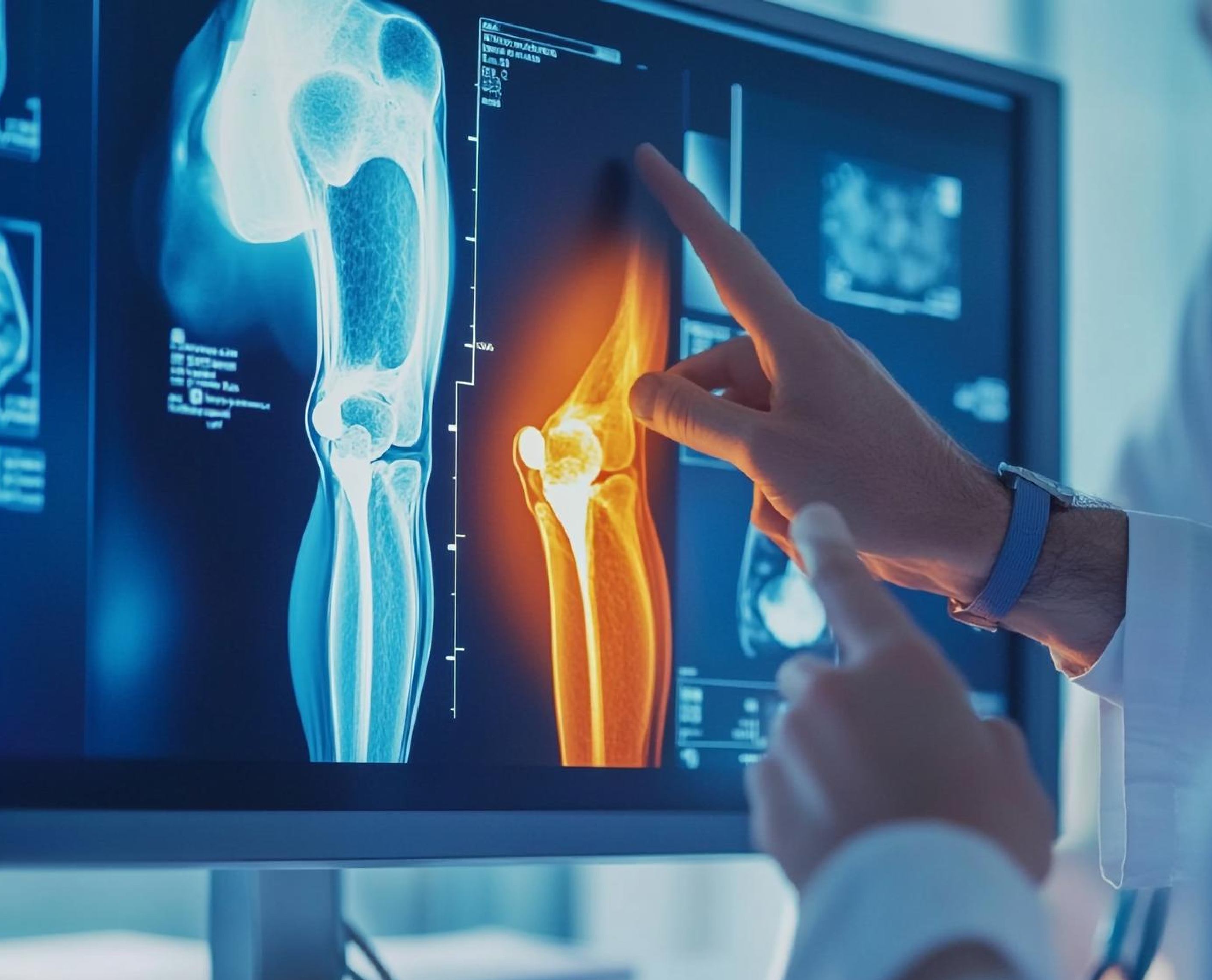
HCG's diagnostic workup for bone tumors integrates plain radiographs, MRI for local extent, CT of
the chest for pulmonary metastases, and bone scan for skeletal survey.
PET-CT is used selectively where whole-body metabolic staging adds clinical value, particularly in
Ewing sarcoma, where disease can be multifocal. Imaging tests are not ordered reflexively; they're
sequenced to answer specific clinical questions efficiently.
Accuracy
HCG performed India's first Computer-Assisted tumor Navigation Surgery (CATS) for bone cancer — a
milestone that reflects the program's commitment to surgical precision.
CATS uses intraoperative imaging and real-time navigation to guide resection, reducing the margin
for error in anatomically complex resections around joints, the pelvis, and the spine. The
technology that makes this possible is the same that allows HCG's surgeons to plan and execute
limb-salvage procedures that would previously have required amputation.
Biomarkers
Blood tests, including alkaline phosphatase and lactate dehydrogenase, have prognostic relevance in
osteosarcoma and Ewing sarcoma and are tracked through treatment. Surgical or needle biopsies are
performed with careful planning; the biopsy tract must be positioned so it can be excised en bloc
with the tumor at the time of definitive surgery. A poorly placed biopsy can compromise limb
salvage. At HCG, this decision is made by the operating surgeon, not delegated.
Limb-Salvage Surgery
Limb-salvage surgery is the surgical goal in the majority of bone sarcoma cases at HCG. The procedure
involves wide resection of the tumor with clear margins, followed by reconstruction of the skeletal
defect.
In appropriately selected patients, limb salvage achieves equivalent oncological outcomes to amputation
while preserving function. Amputation remains an option when tumor growth affects major neurovascular
structures, making safe resection impossible. That decision is made transparently, with the patient and
family fully informed.
Advanced Reconstructions
Reconstructive surgery after tumor resection uses modular mega-prostheses, structural allografts, or
combined approaches depending on the anatomical site and patient age. In growing children, expandable
prostheses allow limb length to be adjusted over time, an important consideration in lower limb
reconstructions.
HCG also offers dedicated 3D printing reconstruction programs, where patient-specific implants and
cutting guides are manufactured from imaging data before surgery, allowing the surgical team to plan
resections and fit custom prostheses with a level of anatomical accuracy that off-the-shelf implants
can't replicate. For complex pelvic, spinal, and joint reconstructions in particular, this capability
meaningfully expands what's achievable in limb salvage.
Minimally Invasive Techniques
Cryosurgery: For selected bone tumors, particularly benign aggressive lesions and
metastatic deposits, doctors recommend cryosurgery, which uses extreme cold (liquid nitrogen) delivered
to the tumor cavity after curettage to extend the effective surgical margin without requiring wider
resection. The extreme cold temperatures destroy residual tumor cells at the cavity wall, reducing local
recurrence risk. It preserves more bone stock than wide resection, which matters for long-term
structural integrity.
Radiofrequency Ablation: Radiofrequency ablation (RFA) uses heat generated by
high-frequency electrical current to destroy tumor tissue. At HCG, RFA is used primarily for painful
bone metastases and select small primary lesions, often as a minimally invasive alternative to open
surgery in patients where systemic disease burden makes major surgery inappropriate.
Systemic Therapies
Most high-grade bone sarcomas are treated with chemotherapy as part of a combined approach. HCG's
medical oncology team administers sarcoma-specific regimens, with dosing guided by the tumor board.
Where molecular profiling identifies actionable targets, targeted therapy is incorporated.
Immunotherapy has an emerging role in sarcoma, and HCG evaluates eligibility for relevant approved
indications and trials.
Supportive Care
HCG's rehabilitation team works with patients from the early post-operative period through recovery,
restoring strength, range of motion, and function. Psycho-oncology support addresses the emotional
weight of diagnosis and treatment, particularly for young patients whose educational and social
lives are affected by prolonged treatment cycles.
Undergoing Treatment for Orthopedic Cancers at HCG
For families and patients seeking orthopedic oncology treatment in Bangalore, HCG offers a program
that spans the full range, from osteosarcoma and Ewing sarcoma to chondrosarcoma, chordoma, and rare
bone pathologies, with the surgical expertise, navigational technology, and multidisciplinary depth
to pursue limb salvage as the default, not the exception. Speak with HCG's orthopedic oncology team
to learn about the treatment options for your condition.