25 Aug, 2026
25 Aug, 2026
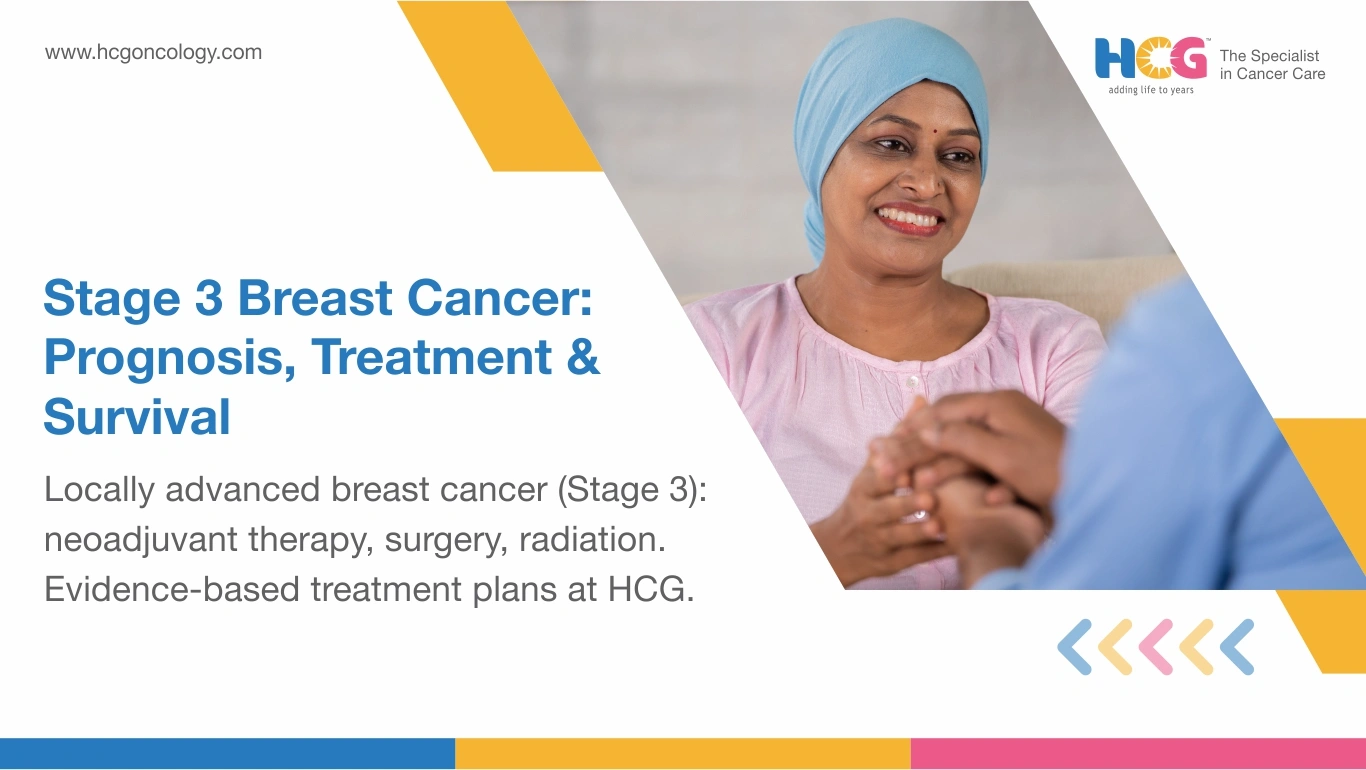
Stage 3 breast cancer is when cancer has spread beyond the breast to nearby lymph nodes or the chest wall but not yet to distant organs such as the lungs or liver. The National Cancer Institute places this in a locally advanced disease category, and treatment at this stage is still often curative.
In India, gaps in screening may result in some cases being diagnosed at a later stage, but treatment for stage 3 breast cancer has improved tremendously. A combination of surgery, neoadjuvant chemotherapy, and radiation therapy is widely used, with coordinated care between oncology teams.
It is a serious stage, but not the same as metastatic disease, and it remains treatable with curative intent in many cases.
Stage 3 breast cancer means the cancer has grown beyond the breast into nearby lymph nodes or surrounding tissues such as the chest wall or skin, but it has not spread to distant organs like the lungs or liver. Breast cancer is classified by the National Cancer Institute as a locally advanced disease, meaning it is still confined to the regional area of the body.
In the TNM staging system, this stage typically involves a larger tumor, significant lymph node involvement (often four or more), or direct extension to nearby structures. The key distinction from stage 4 is the absence of distant metastasis, which is why treatment at stage 3 is still aimed at cure rather than control.
Doctors use the TNM staging system to classify breast cancer, where T tracks tumor size, N counts lymph node involvement, and M flags distant spread. Stage 2 typically involves a smaller tumor with one or two lymph nodes affected. Stage 3 means the tumor has grown larger, reached the chest wall or skin, or pulled in multiple lymph nodes. The gap between the two stages is bigger than the numbers suggest, and the treatment approach shifts significantly as a result.
Can stage 3 breast cancer spread? Left untreated, yes, it can tip into stage 4 and become metastatic. That distinction isn't just academic. It changes the whole treatment.
Stage 3 breast cancer is a serious but still potentially treatable condition. It means the cancer has spread beyond the breast into nearby lymph nodes or surrounding tissues like the chest wall or skin but has not reached distant organs such as the lungs or liver. breast cancer.
Prognosis varies widely and depends more on tumor biology, subtype, and response to treatment than on the stage alone. With modern treatments like chemotherapy, surgery, and radiation, many patients can achieve good outcomes, and a cure may still be the goal in several cases.
Many patients with stage 3 breast cancer will have a complete pathological response to neoadjuvant chemotherapy, meaning that there is no evidence of cancer in the surgical specimen. This is often associated with a better prognosis and improved long-term outcomes.
Even with successful treatment, the risk of recurrence is not zero, and that is why long-term follow-up is necessary. After treatment, there is a period of follow-up over a few years that includes regular check-ups, clinical examinations, and imaging such as mammograms. Recurrence is not a certainty but a risk depending on the biology of the tumor, treatment response, and individual factors.
What does stage 3 breast cancer look like in practice? First, there's usually a larger lump in the breast or visible skin changes, such as dimpling or redness. Second, swelling shows up in the armpit from sentinel lymph node involvement.
But obvious symptoms don't show up in everyone. Some stage 3 diagnoses come from imaging after an earlier screening flagged something worth investigating further.
Younger women don't get stage 3 breast cancer as often, but when they do, it tends to be harder. Triple-negative or HER2-positive subtypes show up more frequently in younger patients, and those grow faster. What happens after a stage 3 breast cancer diagnosis in someone younger? Same treatment path, mostly. But fertility preservation and genetic testing enter the conversation, which adds layers that older patients typically don't face.
Age doesn't protect anyone from advanced breast cancer. Younger women who spot changes in their breasts shouldn't assume they're too young for it to be cancer.
Breast oncology teams at HCG Cancer Hospital manage stage 3 breast cancer using a multi-modal treatment approach tailored to the patient’s stage, molecular subtype, and overall health. Treatment often begins with neoadjuvant chemotherapy to shrink the tumor, followed by surgery and radiation therapy. Depending on the cancer’s biology, targeted therapy or hormone therapy may also be added to improve outcomes and reduce the risk of recurrence. breast cancer
First, genetic counseling covers patients with family history concerns. Second, fertility consultation helps younger women facing tough treatment decisions. Third, structured follow-up surveillance monitors for recurrence long after treatment ends. A multi-disciplinary team, surgical oncologists, medical oncologists, radiation specialists, and pathologists, sits down to discuss each case before any treatment starts.
Disclaimer: This article is for general informational purposes only and is not a substitute for professional medical advice, diagnosis, or treatment. Please consult a qualified healthcare provider for any questions regarding a medical condition.
Feel free to reach out to us.