
This article is medically reviewed by Dr. Lohith G. Reddy, Senior Consultant - Radiation Oncology, HCG Cancer Hospital, K. R. Road, Bangalore.
Advanced CyberKnife Treatment in Bangalore
Patients exploring CyberKnife Treatment in Bangalore are often looking for a way to treat a tumor without going through open surgery. CyberKnife is a robotic stereotactic radiosurgery system built for exactly that.
It delivers highly focused radiation to selected benign and malignant tumors while limiting exposure to the healthy tissue around them. This is possible because the system pairs continuous imaging with robotic radiosurgery, so the beam can track a tumor's exact position throughout a session and adjust automatically if it shifts, even slightly, from something like breathing.
The technology draws on principles from stereotactic body radiation therapy (SBRT) and image-guided radiation therapy (IGRT), providing the care team with a precision radiation therapy approach tailored to each patient.
At HCG, this advanced radiation oncology approach is guided by experienced radiation oncologists and built around personalized treatment planning. Whether CyberKnife is the right fit for a particular patient depends on the tumor's type, size, and location, along with a full multidisciplinary evaluation of that patient's health. With that groundwork in place, here is a closer look at the conditions CyberKnife can treat.
Conditions Treated
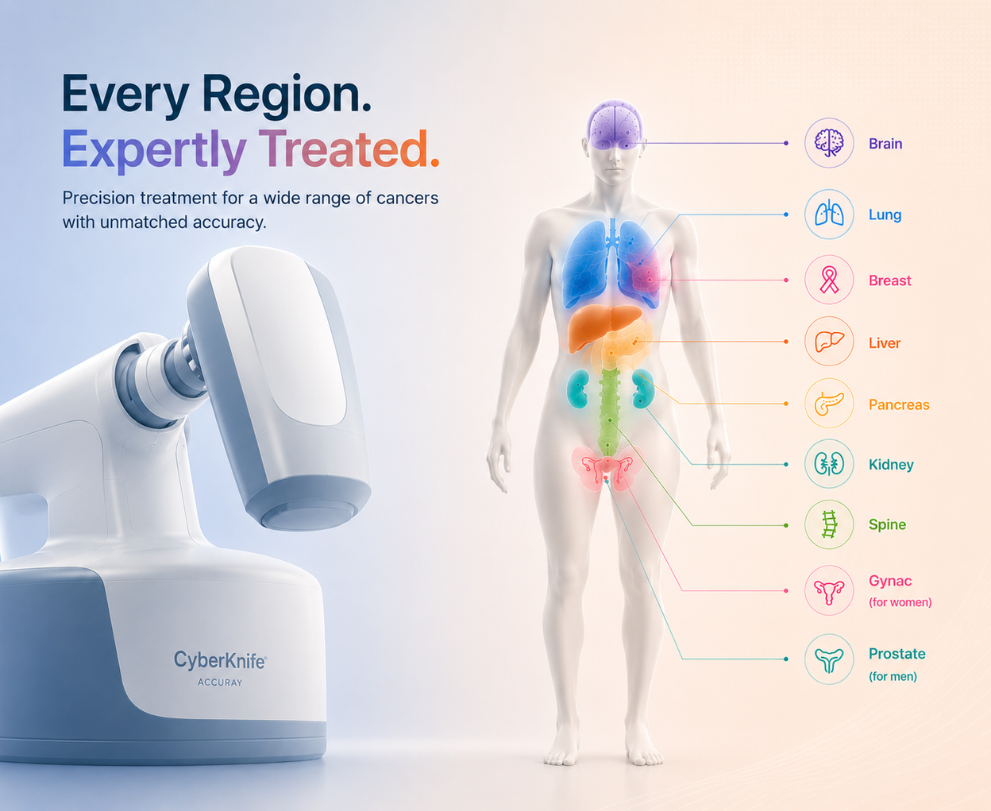
CyberKnife is used to manage a wide range of cancerous and select non-cancerous conditions across the body. Depending on tumor location, size, and a patient's overall clinical picture, this approach may be considered as either a primary treatment or an alternative when surgery carries a higher risk. Each condition is evaluated individually by the care team before a treatment path is confirmed.
Brain Tumors (including Meningioma)
When a brain tumor is well-defined and positioned to allow accurate targeting, CyberKnife may be considered, including for select meningiomas. This makes it one of the more established uses for brain tumor treatment in Bangalore.
Spine Tumors
Because the spinal cord is so sensitive to radiation, CyberKnife's accuracy is particularly valuable here, supporting spine tumor treatment in Bangalore while working to keep the spinal cord itself out of the beam's path as much as possible.
Lung Tumors
Patients who are not ideal candidates for surgery, whether due to tumor location or overall lung function, may be considered for lung cancer radiation therapy in Bangalore using this approach.
Prostate Cancer
For eligible patients, prostate cancer radiation therapy in Bangalore with CyberKnife can often be completed in fewer visits than conventional radiation, which may be a meaningful consideration for some patients' schedules.
Liver Tumors
Liver tumors move with each breath, so CyberKnife's ability to track that motion in real time supports liver tumor treatment in Bangalore for appropriately selected cases.
Pancreatic Tumors
Given how close the pancreas sits to other organs, CyberKnife may be considered for pancreatic tumor treatment in Bangalore, where the tumor's location and the patient's clinical picture support this approach.
Head&Neck Tumors
Select tumors in this region can be treated with focused, image-guided radiation while the team works to protect nearby structures involved in speech, swallowing, and vision.
Recurrent&Metastatic Tumors
For cancer that has returned after earlier treatment or spread to a limited number of sites, CyberKnife is also used for metastatic tumor treatment depending on how many areas are affected.
Who May Be a Candidate for CyberKnife Treatment?
Candidacy for CyberKnife depends on a careful, individualized review of each patient's condition. Patients with localized tumors, meaning tumors that have not spread widely, are often considered good candidates. This approach may also be suitable for tumors located close to critical organs, where conventional surgery could carry a higher risk of complications.
Patients who are not suitable candidates for conventional surgery, whether due to tumor location or overall health, may also be evaluated for this option. In select cases, recurrent cancers requiring re-irradiation may be considered, along with certain metastatic lesions when the number and location of affected sites make focused treatment practical. A comprehensive clinical assessment by the care team is always required before finalizing any treatment decision.
Diagnosis & Treatment Planning
A detailed evaluation is essential before determining whether CyberKnife is the most appropriate treatment option for a patient. Before anyone starts CyberKnife Radiosurgery in Bangalore, the care team works through a detailed evaluation to confirm this is genuinely the right path for that patient.
Clinical Consultation & Medical Assessment
This includes a review of medical history, prior treatments, and a physical evaluation.
Advanced Imaging
CT, MRI, and PET-CT imaging help localize the tumor precisely.
Multidisciplinary Tumor Board Review
Radiation oncologists, medical oncologists, surgical oncologists, and radiologists collaborate to agree on the most suitable plan.
Personalized Radiation Treatment Planning
The team defines the target, plans the dose, and works to protect nearby healthy tissues.
CyberKnife Treatment Procedure
Understanding the treatment journey, from initial planning through follow-up, can help patients feel more prepared and confident before starting care.
Patient Preparation
Patients receive clear instructions ahead of time, which may include imaging markers or positioning aids for accuracy.
Simulation & Treatment Planning
A planning scan maps the tumor in detail, guiding a plan tailored to its size, shape, and location.
Robotic Radiation Delivery
Using frameless radiosurgery technology, the robotic arm delivers radiation from multiple angles without a rigid head frame or invasive fixation device.
Real-Time Tumor Tracking
The system continuously monitors tumor position and adjusts beam delivery accordingly, supporting accuracy even with slight movement.
Post-Treatment Assessment
Patients are monitored and scheduled for follow-up visits to assess tumor response.
Benefits of CyberKnife Treatment
One of the key advantages of CyberKnife is that it is a non-invasive treatment that generally does not require incisions, general anesthesia, or an extended hospital stay. As a non-invasive radiation treatment, it's often chosen for exactly that reason. The following sections outline the potential benefits of CyberKnife treatment.
Non-Invasive Treatment
No incisions, anesthesia, or hospital admission are required for most patients.
High-Precision Radiation Delivery
This is what sets Stereotactic Radiosurgery in Bangalore apart from older radiation methods, targeting tumors with high accuracy while limiting exposure to healthy areas nearby.
Protection of Healthy Tissue
Precise targeting helps preserve surrounding organs and structures.
Real-Time Tumor Tracking
Continuous tracking allows treatment to adapt to natural movement, such as breathing.
Minimal Recovery Time
Because the procedure is non-invasive, patients typically resume normal activities quickly.
Outpatient Treatment in Most Cases
Many patients complete sessions and return home the same day.
Reduced Number of Treatment Sessions
CyberKnife often requires fewer sessions than conventional radiation therapy.
Recovery & Follow-up Care
Most patients return home on the same day as their CyberKnife session, since the procedure does not involve surgery or extended hospital stays. Recovery time can vary depending on the tumor's location and each patient's overall health at the time of treatment.
Following treatment, patients are scheduled for follow-up consultations to monitor progress and address any concerns. Imaging studies are used at appropriate intervals to evaluate how well the tumor has responded to treatment. For select cases, long-term monitoring is recommended to track outcomes and catch any changes early, ensuring continued, coordinated care.
Risks & Possible Side Effects
Side effects of CyberKnife treatment can vary depending on the treatment site and individual patient factors, such as overall health and prior treatment history. Most side effects tend to be mild and temporary, though the care team monitors each patient closely throughout the process.
Fatigue
A general sense of tiredness is common and typically improves over time.
Localized Tissue Reactions
Mild irritation or sensitivity may occur near the treatment area.
Temporary Swelling
Some patients experience short-term swelling that usually resolves on its own.
Organ-Specific Side Effects
Symptoms vary by treated organ and are discussed with patients in advance.
Importance of Follow-up Monitoring
Regular follow-up appointments help the care team identify and manage side effects promptly.
Why Choose HCG for CyberKnife Treatment in Bangalore
Selecting an experienced center for CyberKnife treatment is an important part of the overall care process. Here is what patients can expect from HCG's program for CyberKnife Treatment in Bangalore.
Experienced Radiation Oncology Team
Treatment is guided by experienced radiation oncologists who bring years of clinical expertise to every case.
Advanced Robotic Radiosurgery Technology
HCG's program reflects the same advanced radiation oncology standards found at leading centers, with systems designed for precise, image-guided treatment delivery.
Personalized Treatment Planning
Every treatment plan is designed around the individual patient's tumor characteristics and overall health profile.
Multidisciplinary Cancer Care
A multidisciplinary tumor board reviews each case, bringing together specialists from different fields to support well-rounded decision-making.
Comprehensive Diagnostic Support
Advanced imaging and diagnostic tools support accurate tumor localization and treatment planning from the start.
Patient-Centered Care & Long-Term Follow-Up
HCG focuses on continuity of care, from initial diagnosis through treatment and long-term follow-up, prioritizing patient safety and quality standards at every step.