27 May, 2026
27 May, 2026

This article is medically reviewed by Dr. Adarsh Hegde, Consultant - Radiation Oncology, HCG NMR Cancer Centre, Hubli.
A tumor refers to abnormal cellular growth.
Benign tumors are non-cancerous, often localized, and usually have minimal threat to health unless they exert pressure on vital structures.
Malignant tumors are characterized by uncontrolled cellular growth and division, invasion into surrounding tissues, and metastasis to distant organs. Common causes of malignant tumors range from genetic mutations to environmental factors like tobacco and UV exposure.
A tumor is diagnosed through imaging scans, biopsies, and molecular tests. Treatment interventions vary and include surgery, chemotherapy, radiation therapy, immunotherapy, and targeted therapy.
Understanding the different types of tumors is essential for accurate diagnosis, prognosis, and treatment planning.
From benign growths to malignant tumors that are capable of metastasis, each tumor type poses specific challenges and demands personalized treatment strategies.
The following are the different types of tumors:
Malignant tumors are generally referred to as cancer. These tumors, or cancerous lumps, are characterized by uncontrolled cell growth, invasive behavior, and the potential to spread to distant organs.
These aggressive tumors cause significant health risks, interfere with normal tissue function, and may cause debilitating symptoms. They may occur due to genetic mutations or environmental factors.
Malignant tumors evade the immune system, divide and grow uncontrollably, and disrupt the surrounding tissues, leading to signs of cancer.
Non-malignant or non-cancerous tumors are benign growths or abnormal cell masses that do not invade nearby tissues or metastasize to distant organs.
While patients may have non-malignant tumor symptoms depending on their size and location, they generally have relatively fewer health complications than malignant tumors.
These tumors typically have slow growth rates and may remain asymptomatic for prolonged periods.
Precancerous tumors are also known as pre-neoplastic lesions.
They represent abnormal cell growth with the potential to develop into cancer if left untreated. These lesions have atypical cellular changes, suggesting a progression towards malignancy.
Detection and monitoring of precancerous tumors support early intervention and play a pivotal role in preventing the development of invasive cancer.
Cancer occurs when the cells grow uncontrollably, form masses, and spread to nearby and distant organs. It can affect tissue or organs, disrupt normal bodily functions, and result in severe health complications.
Causes include genetic predispositions, environmental factors like tobacco and ultraviolet radiation, and lifestyle choices. Commonly used cancer diagnosis techniques to determine cancer types and stages include imaging, biopsies, and molecular tests.
Treatments include surgery, chemotherapy, radiation therapy, immunotherapy, and targeted therapy.
Additional Reading: What is Cancer - Types, Causes, Treatment and Prevention.
Cancer is characterized by the abnormal growth of cells in different body parts, each with unique characteristics.
Understanding the differences in these characteristics is vital for accurate diagnosis and customized treatment strategies. The following are the different types of cancer:
Carcinomas are the most common type of cancer. It initiates in the epithelial tissues lining organs and body surfaces.
Different types of carcinoma include squamous cell carcinomas (skin, lungs, and esophagus), adenocarcinomas (glandular tissues), and basal cell carcinomas (skin).
Early detection through screening techniques like mammograms and Pap smears enhances treatment outcomes.
These cancers develop in connective tissues, such as bones, muscles, fat, and blood vessels. They are relatively less common compared to carcinomas.
Different types of sarcoma include liposarcoma (fat), osteosarcoma (bone), and leiomyosarcoma (smooth muscle).
It is a cancer of the blood-forming tissues, including the bone marrow and lymphatic system. The disease is characterized by the abnormal production of white blood cells.
Types include acute lymphoblastic leukemia (ALL), chronic lymphocytic leukemia (CLL), acute myeloid leukemia (AML), and chronic myeloid leukemia (CML).
These are cancers originating in the lymphatic system. They comprise Hodgkin's lymphoma and non-Hodgkin's lymphoma (NHL), with NHL being more common.
Treatment includes chemotherapy, radiation therapy, immunotherapy, and stem cell transplantation.
It is a type of skin cancer originating in melanocytes. Melanocytes are the cells that produce melanin. It can develop on normal skin or from existing moles. Melanoma is highly aggressive and prone to metastasis if not detected early.
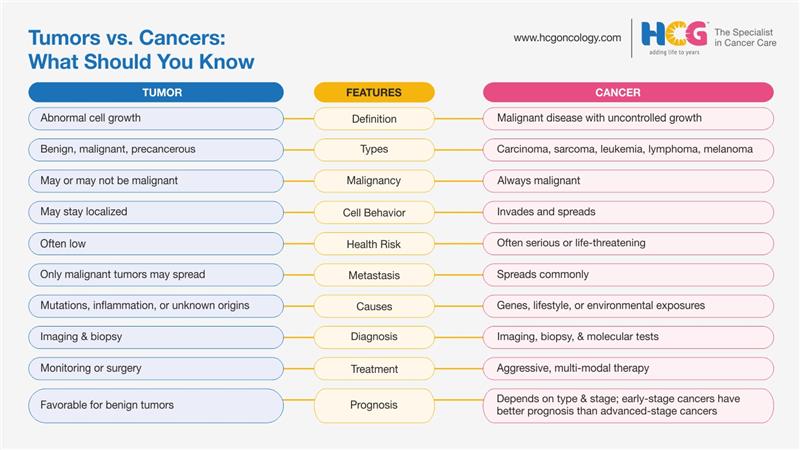
"Tumor" and "cancer" are often used interchangeably, but they have distinct meanings in medical terminology. It is important to understand the differences between tumors and cancer.
Understand the dynamics of tumor vs. cancer here:
Cancer is a malignant disease that can spread to various parts of the body and cause various health complications.
Tumors, on the other hand, refer to abnormal growths, which may be benign or malignant. While malignant tumors need aggressive treatments, benign tumors do not pose significant health risks.
Cancer consists of malignant cells that proliferate uncontrollably, forming invasive tumors capable of metastasis.
In contrast, tumors can be benign or malignant; benign tumors cannot spread.
Cancer, with its ability to spread to nearby and distant organs, can be life-threatening, often leading to severe health complications, including death, if untreated.
In contrast, benign tumors may cause health complications that may not necessarily be life-threatening.
Cancer has the potential to metastasize and significantly affect the prognosis. In contrast, tumors do not always metastasize. While malignant tumors can spread, benign tumors typically remain localized and do not invade nearby tissues.
The causes of cancer involve an interplay of genetic, environmental, and lifestyle factors. Genetic mutations acquired during life or inherited from parents can disrupt normal cell growth regulation, leading to cancer.
Environmental exposures such as tobacco smoke, ultraviolet radiation, and carcinogenic chemicals may also lead to DNA damage and thereby increase cancer risk.
Lifestyle choices like lack of physical activity, poor diet, and excessive alcohol consumption also contribute to the development of cancer.
Chronic infections from viruses like HPV and hepatitis B and C can predispose individuals to certain cancers. Understanding and mitigating these risk factors through preventive measures, screening, and early detection are important.
Numerous types of gene mutations can contribute to an increased risk of certain cancers. Activation of oncogenes, like EGFR and HER2, results in excessive cell growth.
Tumor suppressor genes regulate cell division and repair DNA damage. Mutations in tumor suppressor genes may cause uncontrolled growth.
DNA repair genes safeguard genomic stability; defects in DNA repair genes, like BRCA1/2, increase cancer risk.
Fusion genes are formed from abnormal gene rearrangements. These can promote cancer development, such as BCR-ABL in chronic myeloid leukemia.
Cancer spreads through metastasis, wherein cancer cells break free from the primary tumor, invade nearby tissues, enter blood or lymphatic vessels, and spread to distant sites in the body.
Once at a secondary location, cancer cells multiply, forming new tumors. The occurrence of metastasis depends on the complex interactions between cancer cells and their microenvironment, involving cell adhesion molecules and signaling pathways.
Metastasis contributes significantly to cancer morbidity and mortality. Understanding the mechanisms underlying metastasis is essential for developing effective strategies to prevent and treat advanced disease.
Treatment for benign and malignant tumors depends on their size, location, and potential impact on health. Benign tumors often require monitoring. However, they may be surgically removed if they cause symptoms.
Cancer, on the other hand, demands more aggressive treatment, involving surgery, chemotherapy, radiation therapy, immunotherapy, or targeted therapy, customized to cancer type, stage, and patient factors.
Unlike in the case of benign tumors, cancer treatments aim to eradicate cancer cells, prevent recurrence, and prolong survival. Multidisciplinary approaches are implemented to optimize outcomes and routinely monitor for tumor recurrence or cancer progression.
It is necessary to have a basic understanding of the various aspects associated with tumor vs. cancer.
Being aware of the differences between tumors and cancer aids patients in making informed health decisions and helps doctors deliver the right kind of treatment. Be it a benign tumor or a malignant one, timely intervention and personalized care are essential for effective management.

Dr. Adarsh Hegde
Consultant - Radiation Oncology
MBBS, MD (Radiation Oncology)
Dr. Adarsh Hegde is a seasoned radiation oncologist who specializes in treating and managing a broad spectrum of cancers, including brain tumors, head and neck cancers, lung cancers, sarcomas, lymphomas, cervical cancer, endometrial cancer, and more. He also has a special interest in the non-oncological application of radiation treatments. Intracavity brachytherapy in gynecological cancers, cancer pain management and palliative care, and concurrent chemotherapy. Dr. Adarsh Hegde believes in pain-free and comfortable treatment with minimal intervention, thereby focusing on the quality of life of cancer patients while striving to achieve a complete cure.
Appointment Link: Book an Appointment with Dr. Adarsh Hegde.
Feel free to reach out to us.