25 Aug, 2026
25 Aug, 2026

This article is medically reviewed by Dr. Ganesh Agarwal, Consultant - Head & Neck Surgical Oncology.
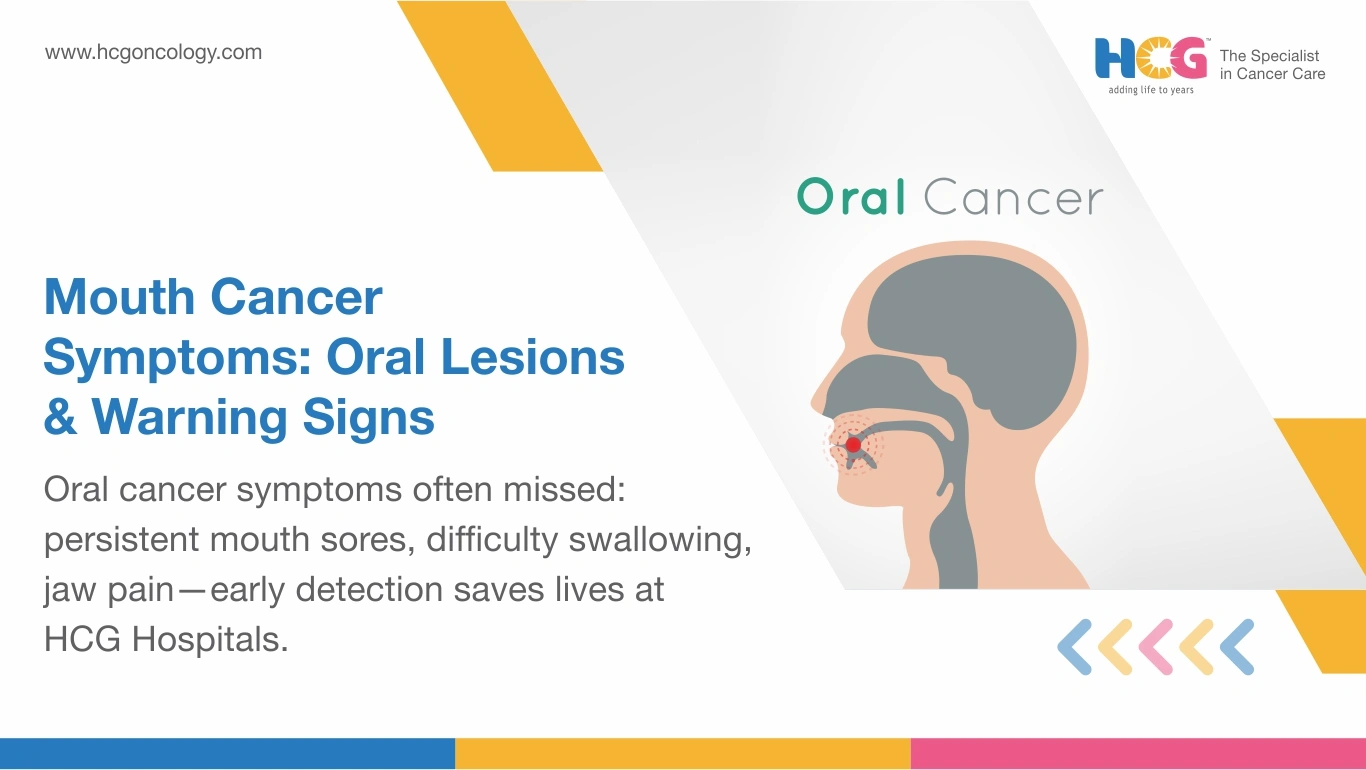
Mouth cancer symptoms are not always painful in the early stages, which can make them easy to overlook. A persistent mouth ulcer, a white or red patch, or a lump inside the mouth may be among the first signs. Recognizing these changes early can help ensure timely diagnosis and treatment.
According to WHO data, oral cancer is one of the most common cancers in India, largely linked to tobacco and betel nut use. Persistent mouth sores, white or red patches, and unexplained changes inside the mouth should be evaluated by a specialist.
Obvious visual signs are not always how oral cancer presents in the early stages. Oral cancer can include white patches in the mouth, known as leukoplakia, and red patches, called erythroplakia. Both are considered precancerous lesions that develop on the lining of the oral cavity.
According to the National Institute of Dental and Craniofacial Research, oral cancer can affect the lips, tongue, cheeks, floor of the mouth, and throat. Other warning signs may include a non-healing sore, persistent swelling, difficulty swallowing, and unexplained numbness in the mouth.
Is mouth cancer painful in the early stages? In many cases, early mouth cancer may not cause significant pain, which is one reason symptoms are often overlooked initially. A painless lump or persistent patch inside the mouth may not seem serious at first, so many people delay getting it evaluated for months.
Delays in evaluation can affect how early oral cancer is diagnosed and treated. Many specialists emphasize that persistent mouth changes should be examined early, especially when symptoms continue for more than two weeks.
Stage 1 mouth cancer has telltale signs that shouldn't be ignored. First, a persistent mouth sore that doesn't heal within two to three weeks is one of the most common early indicators. A mouth ulcer that won't heal after two to three weeks should always be evaluated by a specialist.
Second, pain in the mouth and jaw of cancer patients, described as dull and constant, or numbness in the lip, can point to an underlying problem. Third, difficulty swallowing and oral cancer signs, including a feeling that something is caught in the throat, deserve prompt attention.
Most early-stage oral lesions are small, under 2 cm, and they haven't spread to the neck lymph nodes. But staying small without treatment isn't what they do. It's a bit like ignoring a crack in your windshield. It starts small, but heat, cold, and time will make it spread.
One of the most common sites for squamous cell carcinoma of the oral cavity is the tongue. Mouth cancer symptoms under the tongue include a hard lump, pain that radiates to the ear, and restricted tongue movement. If your tongue has lost range of motion or you notice persistent pain on one side, that's a red flag worth investigating. Many doctors won't say outright that tongue cancer in younger patients, actually, anyone under 45, isn't as rare as it used to be, and it's showing up more frequently in people without traditional risk factors.
Swelling, bleeding gums that don't respond to dental treatment, and loose teeth without an obvious dental cause are how gum cancer often shows up. Gum cancer can closely resemble gum disease in its early stages, which is why a biopsy matters for getting a definitive answer. If your dentist can't explain the symptoms with a dental diagnosis, a different kind of specialist is what you need.
A sore on the lip that doesn't heal, thickened skin, or a lump are the primary warning signs. Lip cancer symptoms are more visible compared to other oral cancers, they are more visible, and most lip cancers actually get caught earlier because they're hard to ignore in the mirror. But people still wait too long sometimes, assuming it's just a cold sore or dry skin that won't go away. It's like a persistent warning light you keep covering with tape instead of investigating.
Can mouth cancer start as an ulcer? It can. But cancer isn't what most mouth ulcers are. A regular ulcer heals within one to two weeks, hurts, and responds to topical treatment. What a cancerous sore does is persist beyond three weeks, refuse to respond to treatment, and may bleed without provocation. Think of a normal ulcer, like a scraped knee. It stings, but it heals on its own. A cancerous sore is like a wound that keeps reopening, no matter what you do.
Here's how they compare:
| Feature | Common Mouth Ulcer | Mouth Cancer Sore |
|---|---|---|
| Duration | Heals in 1-2 weeks | Persists beyond 3 weeks |
| Pain | Usually painful | Often painless early on |
| Appearance | Smooth, round edges | Irregular, raised borders |
| Bleeding | Rare | Common with minimal contact |
| Response to treatment | Improves with topical care | Doesn't respond |
It is important to recognize that persistent mouth sore causes often get attributed to stress or diet when the actual issue is a lesion that hasn't been properly examined. Is mouth pain always cancer? It isn't. Most mouth pain comes from dental issues or infections. But pain combined with a non-healing sore warrants a closer look from a specialist.
They can, and they should be. Dentists are often the first to spot suspicious oral lesions during routine checkups. Can dentists detect mouth cancer early? Through visual examination and tools such as VELscope / Identafi, they can flag areas that need further evaluation.
But a diagnosis on its own isn't what a visual check provides. What an oral cancer diagnosis requires is a biopsy, where tissue from the suspicious area is sent to a pathologist for examination.
TNM staging (oral) is used to determine size, lymphadenopathy involvement, and whether metastasis has occurred. A non-healing sore plus lymph node swelling in the neck shouldn't be dismissed without thorough investigation. A lot of oral cancers get caught later than they should because people don't think of their dentist as a cancer screener.
The list of risk factors for oral cancer is topped by tobacco use. Smoking, chewing tobacco, and betel nut chewing are the primary drivers of oral cancer in India, and these habits remain widely prevalent in many regions. HPV-related oral cancer is also on the rise globally, particularly in younger patients. Mouth cancer symptoms in smokers tend to involve the floor of the mouth and the lateral tongue, and the location pattern shifts based on the type of tobacco exposure. Heavy alcohol use adds another layer of risk on top of tobacco.
In India, most oral cancers are preventable, but cultural habits make prevention more challenging than it might seem on the surface. Head and neck oncology teams in cities like Bengaluru, Mumbai, and Kolkata see these cases regularly, and they consistently emphasize is the importance of early intervention.
Three practical steps make a difference. First, reducing tobacco use cuts risk considerably and is the single most impactful change a person can make.
Second, regular dental screenings catch problems before they escalate into advanced-stage disease. Third, awareness of early symptoms of mouth cancer gives people a reason to act sooner and get evaluated promptly.
Oral oncology and head and neck oncology specialists at HCG Cancer Hospital handle the full range of oral cancer diagnosis and treatment. From biopsy to TNM staging, the team develops a plan around each patient's disease profile. What patients can expect is a complete evaluation that includes clinical examination, imaging, and pathology review, followed by a clear treatment plan.
Multidisciplinary tumor board reviews, where surgeons, radiation oncologists, and medical oncologists collaborate on complex cases, are also part of HCG Cancer Hospital offers.
whether that stubborn mouth sore needs attention, it does. Don't wait to find out whether it's something serious. Learn about early cancer warning signs that shouldn't wait.
Book an oral cancer screening consultation at your nearest HCG Cancer Hospital center.
Disclaimer: This article is for general informational purposes only and is not a substitute for professional medical advice, diagnosis, or treatment. Please consult a qualified healthcare provider for any questions regarding a medical condition.
Dr. Ganesh Agarwal
Consultant - Head & Neck Surgical Oncology
Appointment Link: Book an Appointment with Dr. Ganesh Agarwal
Feel free to reach out to us.