25 Aug, 2026
25 Aug, 2026

This article is medically reviewed by Dr. Abhishek Charan, Consultant - Medical Oncology.
Skin cancer is detected through the presence of small changes in one’s skin. Such changes may include the development of moles, a lesion that won't heal, or even a newly formed patch on one’s skin. Most of these symptoms are usually painless and easy to overlook.
Common warning signs of skin cancer include:
Most skin cancer warning signs share a few common threads: A new growth that wasn't there before, a mole shifting color or shape, or a sore that bleeds, scabs over, and bleeds again. The appearance changes depending on type.
What does skin cancer look like? Basal cell carcinoma might show up as a pearly bump or a flat skin lesion that's easy to write off as harmless. Squamous cell carcinoma comes as a firm red nodule or a scaly patch. Melanoma symptoms in early stages involve a pigmented lesion (a dark or multi-colored spot) that's asymmetrical or carrying more than one color.
Can skin cancer look like a pimple? It can. Some basal cell carcinomas look just like pimples that won't go away. Skin cancer for months before anyone takes a closer look, which is what makes early detection so tricky.
Normal moles are usually symmetrical, evenly colored, and stable over time.
Melanoma, on the other hand, often shows asymmetry, irregular borders, multiple colors, and continuous change.
The ABCDE rule helps distinguish between the two, but dermoscopy is required for confirmation.
Dermatologic oncology teams rely on the ABCDE rule when evaluating suspicious moles.
It goes like this:
Not every atypical mole winds up being cancerous. But any mole that hits two or more of these deserves a dermoscopy exam.
Different types show up differently on the skin, and knowing the difference helps.
An itchy mole and skin cancer can sometimes be connected. Early-stage skin cancer typically doesn't hurt. An itchy mole and skin cancer can sometimes be connected, but itching alone isn't a reliable indicator.
And bleeding mole warning signs are more concerning. A mole that bleeds without being injured should be checked promptly. Pain and itching tend to show up late in the game. Put simply, no pain doesn't mean no disease.
Skin cancer symptoms on the face include persistent sores near the eyes, nose, or lips that won't close up within four weeks; pearly bumps that slowly get bigger; and red patches that don't respond to moisturizers or topical treatments.
Skin cancer symptoms on scalp? Trickier to spot because hair covers everything up. In India, men with thinning hair and outdoor jobs carry a higher risk for scalp lesions.
Although skin cancer is less common in individuals with darker skin tones, it can still occur and may be diagnosed at a later stage due to delayed recognition.
Unlike skin cancers that commonly develop on sun-exposed areas, melanoma in darker skin is more likely to appear on:
Warning signs include dark streaks under the nails, non-healing sores, new pigmented lesions, or changes in existing spots. Any unusual skin change that persists should be assessed by a dermatologist, regardless of skin tone.
Any new mole after age 30 deserves attention. Any existing mole that shifts in size, shape, or color should be evaluated by a dermatologist.
And any skin lesion that bleeds or refuses to heal within a month? That needs a professional assessment.
Regular mole monitoring matters because waiting for obvious symptoms means missing early changes.
Most moles are harmless. But the ones that aren't can become life-threatening if they're ignored, and telling the difference by eye alone isn't something most people can pull off reliably.
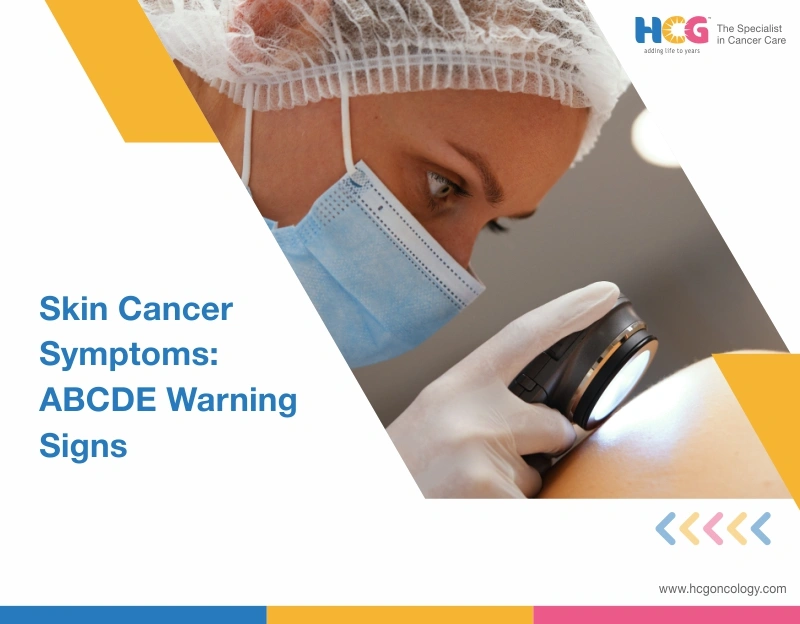
A suspicious skin lesion triggers a specific process. The dermatologist starts with dermoscopy, a magnified examination of the pigmented lesion that reveals structural patterns not visible to the naked eye. If it looks concerning, a skin biopsy follows for microscopic examination.
The distinction is important. Dermoscopy shows what's on the surface. A biopsy shows what's happening beneath the skin. It's like comparing the paint job on a wall to pulling out a section and checking for water damage behind it. Symptoms of stage 1 skin cancer are often limited to the skin surface.
Stage 1 skin cancer typically remains confined to the outer layers of the skin. Symptoms may include a small abnormal mole, a flat lesion, or a slightly raised growth that changes slowly over time.
There is usually no pain, which is why early-stage skin cancer is often overlooked without regular skin checks.
For melanoma, staging may involve sentinel lymph node biopsy to check whether cancer cells have moved beyond the primary site. A skin cancer rash that seems minor can tell a very different story under the microscope, and that's why biopsy confirmation is so crucial.
Most oncologists agree that dermoscopy paired with biopsy remains the most reliable pathway for diagnosing skin cancer at any stage.
A dermatologic oncologist uses several methods, such as dermoscopy, biopsy, and imaging, among others, to determine the cause of the skin cancer. Personalized treatment plans are offered depending on the type, stage, and nature of the skin cancer that affects a person.
The effectiveness of the process is associated with early detection and treatment. All procedures are offered under one roof; therefore, an early consultation with a specialist will ensure better results for a patient.
Book a skin cancer screening consultation at your nearest HCG Cancer Hospital center.
Disclaimer: This article is for general informational purposes only and is not a substitute for professional medical advice, diagnosis, or treatment. Please consult a qualified healthcare provider for any questions regarding a medical condition.
Feel free to reach out to us.