11 Aug, 2026
11 Aug, 2026

This article is medically reviewed by Dr. Unmesh Mukherjee, Consultant - Radiation Oncology, HCG - ICS Khubchandani Cancer Centre, Colaba.
CyberKnife vs. Conventional Radiotherapy is one of the most consequential treatment comparisons a cancer patient may face. HCG Cancer Hospital offers both CyberKnife and conventional radiotherapy for different types of cancers and certain non-cancerous conditions.
CyberKnife is a stereotactic radiation system delivering sub-millimetre precision, high-dose radiation in 1 to 5 sessions. Conventional radiotherapy uses a fixed-gantry LINAC across 20 to 30 daily visits.
The two differ in accuracy, session count, side-effect profile, and clinical suitability. Understanding these CyberKnife benefits versus conventional approaches helps patients ask sharper questions before committing to any radiation plan.
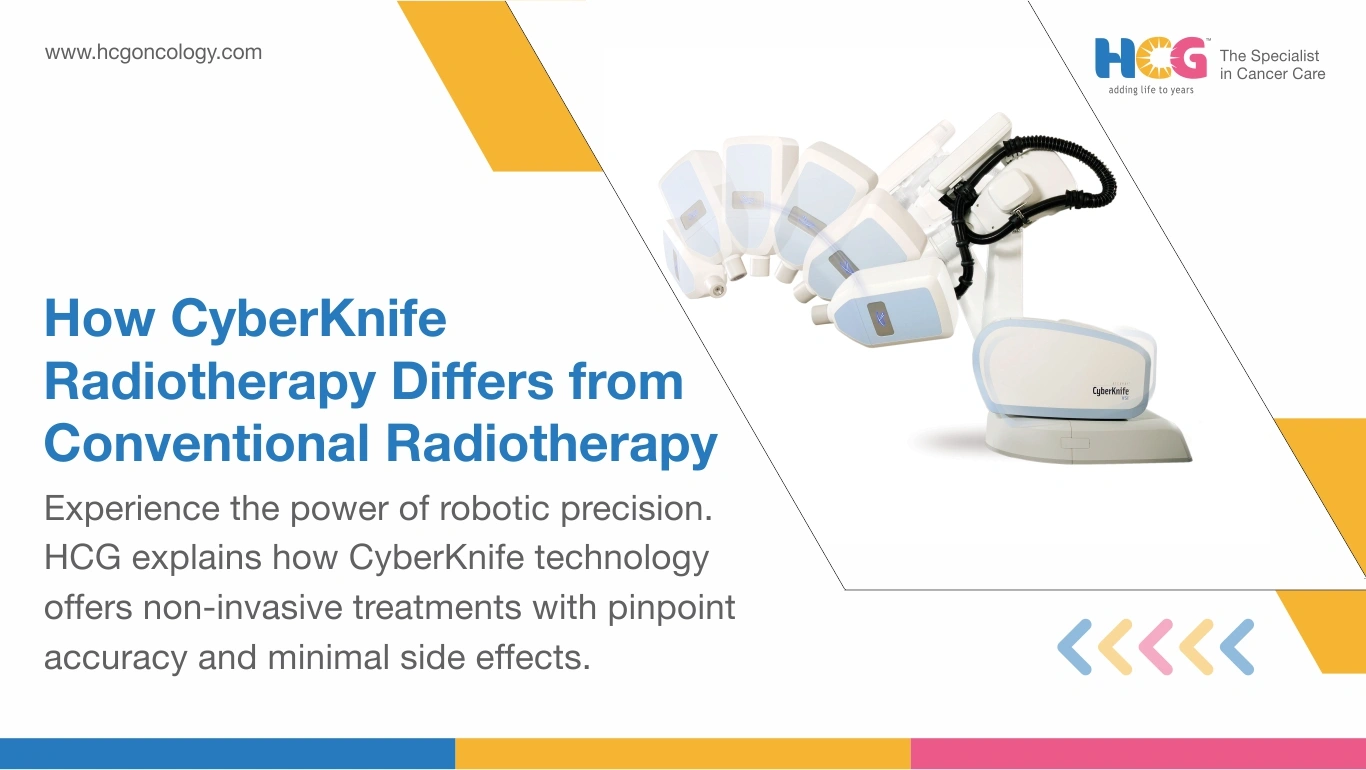
CyberKnife is a radiosurgery system that operates without the need for a rigid frame. At its core is a compact linear accelerator, mounted on a versatile robotic arm. This arm directs concentrated radiation beams, originating from over 1,200 distinct angles. Beam collimation shapes each beam so that it focuses energy exactly on the tumor and limits scatter to nearby tissue.
Two real-time imaging systems run simultaneously during every session, cross-referencing the tumor's live position against the pre-treatment plan. If the target drifts beyond a pre-set threshold, beam delivery pauses automatically until the anatomy realigns.
| Parameter | CyberKnife (SBRT) | Conventional Radiotherapy |
|---|---|---|
| Sessions | 1 to 5 sessions | Up to 40 sessions |
| Precision margin | Sub-millimeter | Larger margins |
| Motion management | Real-time robotic tracking is involved; respiratory gating can also be used. | Respiratory gating or breath-hold. |
| Treatment setting | Outpatient | Outpatient (daily visits) |
| Anesthesia | Usually not required, but in some cases, anesthesia may be used. | Usually not required, but in some cases, anesthesia may be used. |
| Total duration | 1 to 2 weeks | 4 to 8 weeks |
When comparing CyberKnife vs. traditional radiotherapy, the core difference is the dosing strategy. Conventional radiotherapy delivers small daily doses, typically 1.8 to 2.5 Gy per fraction, using hypofractionation as a deliberate tissue-protection strategy. This fractionation provides healthy tissue recovery time between visits and remains appropriate for a wide range of tumor types.
CyberKnife operates on stereotactic body radiation therapy (SBRT) principles, using an advanced treatment planning system to map hundreds of converging beam angles. Each session carries a higher ablative dose, often 5 to 20 Gy per fraction, concentrating destructively at the tumor while surrounding structures absorb only a fraction of the total energy.
CyberKnife maintains sub-millimeter positional accuracy throughout delivery, achieved through continuous isocenter targeting corrections made by the robotic arm in real time. Conventional image-guided radiation therapy (IGRT) verifies patient position before each session but does not apply correction during the beam-on phase itself.
Respiratory motion can shift a lung or liver lesion by 10 to 25 mm during a normal breath cycle. CyberKnife's tracking compensates dynamically without pausing treatment.
CyberKnife can reduce incidental radiation exposure to healthy tissue in appropriate candidates. The radiation oncology team at HCG's NABH-accredited centers evaluates each patient's anatomy and proximity to critical structures before recommending either modality.
| Side Effect Factor | CyberKnife (SBRT) | Conventional Radiotherapy |
|---|---|---|
| Precision margin | Sub-millimeter | Larger margins |
| Healthy tissue exposure | Minimal, due to converging beam angles | Higher, cumulative up to 8 weeks |
| Fatigue | Mild, within 24 to 48 hours post-session | Cumulatively builds over treatment weeks |
| Skin reaction | Side effects are rarely significant and less troublesome, with a better quality of life. | Rawness or dryness at the beam entry site; inconvenience of prolonged treatment with longer duration of side effects. |
| Mucositis risk | Low for most sites | Moderate to high for head and neck cases |
| Bowel or bladder sensitivity | Minimal for most indications | Possible with pelvic tumors |
| Swelling or local heaviness | Can occur near the brain or the spinal cord | Can occur depending on the treatment site |
| Radiation recall reaction | Monitor if on concurrent systemic therapy | Monitor if on concurrent systemic therapy |
CyberKnife is not side-effect-free. Fatigue, localized swelling, and a dull heaviness around the treated area can occur, particularly near the brain or spinal cord.
Patients on concurrent systemic therapy should be aware of radiation recall reactions, a recognized response that the clinical team monitors during follow-up. Side-effect profiles depend on individual factors and cannot be generalized across all patients.
CyberKnife requires 1 to 5 sessions, each lasting 30 to 90 minutes. Five sessions of stereotactic body radiation therapy can control tumors just as well as traditional multi-week treatments, and it may be easier for some patients to handle.
Typically, this compressed schedule reduces travel burden significantly for patients from Tier 2 cities or rural regions. HCG Cancer Hospitals in Bangalore and Colaba (Mumbai) offer outpatient CyberKnife services within the HCG network.
No. CyberKnife is not universally applicable. Established indications include prostate, brain, spine, lung, and liver cancers, plus spinal metastases, acoustic neuromas, meningiomas, and small lung nodules.
Single-fraction SRS treats intracranial targets such as brain metastases or acoustic neuromas. Multi-fraction SBRT is preferred for spinal and body targets where dose fractionation protects adjacent cord structures. CyberKnife handles both on the same platform.
CyberKnife is generally not appropriate for large or diffusely infiltrating tumors or cases requiring extensive irradiation of lymph node fields. At HCG, every radiation case is reviewed through a multidisciplinary tumor board, with cancer recurrence monitoring built into the post-treatment protocol from the first follow-up visit.
CyberKnife is non-invasive and produces no physical sensation during beam delivery. Patients lie on a contoured treatment couch without frames, pins, or restraints. The robotic arm moves quietly around the body throughout each session.
Where fiducial markers have been placed before treatment, the small insertion site requires brief monitoring afterward, though no formal wound care is needed. Mild fatigue within 24 to 48 hours is the most commonly reported post-session experience.
Most patients resume light daily activities within 24 to 48 hours. Post-treatment support at HCG includes structured follow-up imaging at 4 to 12-week intervals, nutritional guidance for thoracic or abdominal cases, and fatigue management protocols during the first week.
For spinal lesions, physiotherapy referral supports neurological rehabilitation. Steroid tapers following brain radiosurgery are supervised by the treating oncologist.
Recovery after conventional radiotherapy involves a longer aftercare timeline. Cumulative fatigue typically peaks one to two weeks after the final session before gradually resolving. Skin reactions at the beam entry site require regular moisturizing and sun protection.
HCG manages region-specific effects such as mucositis, bowel sensitivity, or urinary frequency through specialist supportive care. Patients on systemic therapy receive specific guidance on monitoring for radiation recall reactions during future chemotherapy cycles. Structured follow-up imaging, nutritional support, and survivorship access continue throughout.
Choosing where to receive CyberKnife treatment is not a small decision. For many patients, what matters most is knowing the team has performed the procedure many times and that the technology is in skilled hands.
At HCG, CyberKnife is delivered by radiation oncologists who work closely with a multidisciplinary team. The system tracks tumor movement in real time, adjusting for breathing and subtle shifts, which means surrounding healthy tissue stays as protected as possible.
Disclaimer:This information is intended to educate patients and caregivers. It does not replace professional medical advice. All treatment decisions should be made in consultation with a qualified doctor.
Dr. Unmesh Mukherjee
Consultant - Radiation Oncology
MBBS, MD (Radiotherapy)
Dr. Unmesh Mukherjee is a senior Radiation Oncologist at HCG ICS Khubchandani Cancer Centre, Colaba, specializing in precision radiation oncology. He has extensive expertise in advanced technologies such as CyberKnife, MR-LINAC, SRS, and SBRT, enabling highly targeted and effective cancer treatment. Dr. Mukherjee treats complex cancers, including brain tumors, breast cancer, and prostate cancer.
Appointment Link: Book an Appointment with Dr. Unmesh Mukherjee
Feel free to reach out to us.