30 Jul, 2026
30 Jul, 2026

This article is medically reviewed by Dr. Unmesh Mukherjee, Consultant - Radiation Oncology, HCG - ICS Khubchandani Cancer Centre, Colaba.
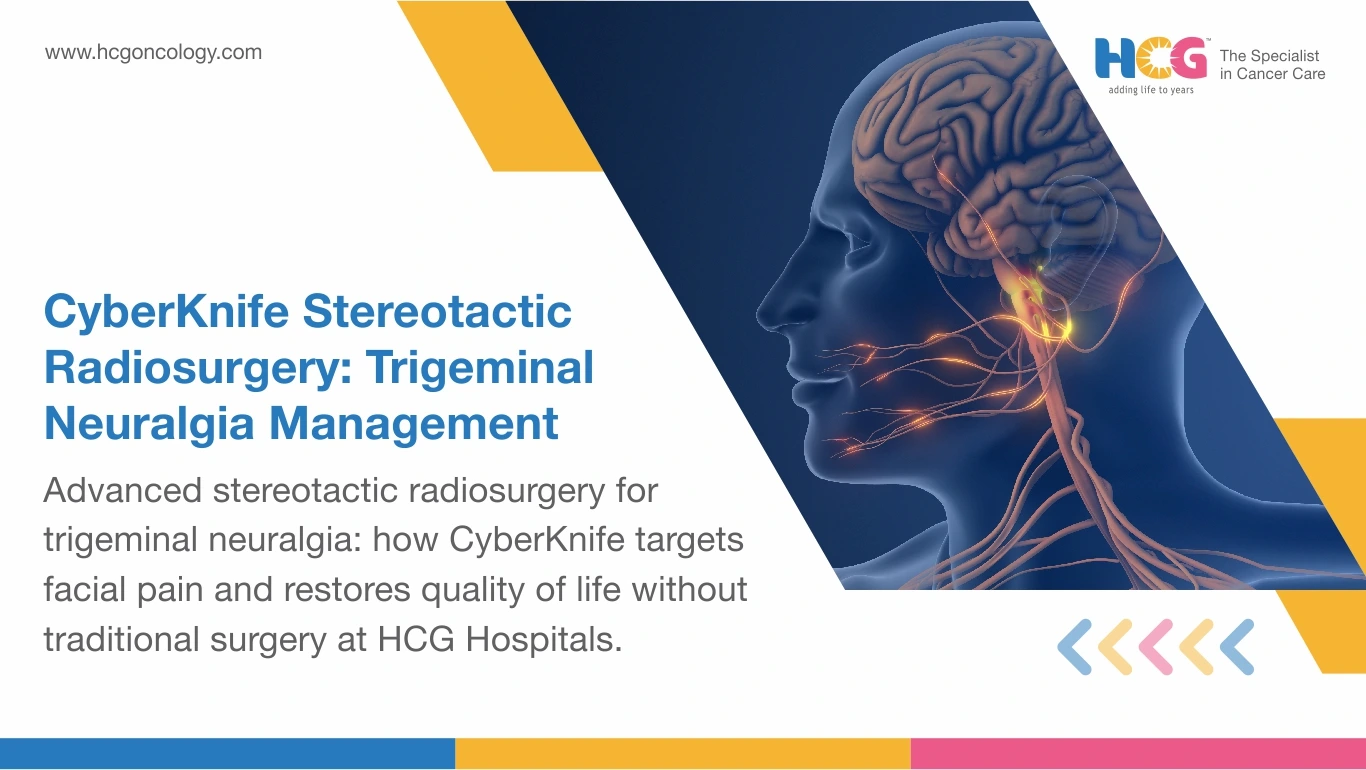
The trigeminal nerve runs from the brainstem and branches across the face, carrying sensation to the forehead, cheek, and jaw. When a blood vessel presses against this nerve at the brainstem, the nerve misfires. The result is episodes of intense neuropathic pain that can last seconds or minutes and return dozens of times a day.
Medication helps at first. It stops helping many patients. When that happens, CyberKnife treatment for trigeminal neuralgia becomes a clinically relevant option. It uses stereotactic radiosurgery to deliver precision radiation therapy directly to the nerve root, disrupting the pain signals without any incision, anesthesia, or hospital stay.
This blog explains the procedure, patient selection process, clinical evidence, side effects, recovery, and why HCG is the right center for this treatment.
Most cases of trigeminal neuralgia involve a blood vessel, usually an artery, pressing against the nerve root where it exits the brainstem. This contact damages the protective myelin sheath around the nerve. Damaged myelin allows electrical signals to short-circuit. The result is spontaneous pain firing, or pain triggered by the lightest physical stimulus.
CyberKnife does not remove the blood vessel. It targets the nerve root itself. The system fires hundreds of radiation beams simultaneously from positions distributed around the patient's head. Each beam is individually weak.
At the single point where they all converge on the nerve root, the combined dose is strong enough to cause a controlled biological change in the nerve tissue that reduces its capacity to generate pain signals.
Pain does not reduce immediately after treatment. The nerve tissue changes slowly following radiation exposure. Most patients begin noticing a difference somewhere between two weeks and three months after the session.
Some achieve complete freedom from facial nerve pain. Others experience a significant reduction in episode frequency and severity that brings their condition back under manageable control. Formal outcome assessment happens at six months.
Trigeminal neuralgia is first treated with anticonvulsant medication. Carbamazepine is the standard starting point. For patients who respond, surgery is deferred indefinitely.
For those who stop responding, develop side effects that cannot be managed, or whose pain breaks through at doses that are too high to tolerate, the conversation shifts to intervention.
CyberKnife sits within that interventional discussion. It is not the first step, and it is not appropriate for every patient. A neurosurgeon and radiation oncologist assess each case jointly. They examine the imaging, the pain history, the medication trajectory, and the patient's overall medical status before making any recommendation.
Published data from multiple clinical series report pain relief in 70 to 90 percent of treated patients. Those with a clear imaging finding of vascular nerve compression and a classic pain pattern tend to achieve the strongest results.
Patients with atypical presentations or secondary trigeminal neuralgia related to another condition show more variable outcomes. Recurrence at five years occurs in roughly 20 to 40 percent of cases. In selected patients, a second course of radiosurgery is clinically feasible.
CyberKnife for trigeminal neuralgia is an outpatient procedure. Patients are not admitted. They do not receive general anesthesia. There is no incision, no implant, and no wound to care for afterward. The full visit takes approximately two to three hours from arrival to departure.
Before treatment, the patient undergoes MRI and CT imaging in the treatment position. These scans give the clinical team a precise anatomical map of the trigeminal nerve root and the structures around it. From that data, an individualized treatment plan is built, specifying exactly where the radiation will be directed, at what angle, and in what dose.
Radiation delivery itself runs between 60 and 90 minutes. The patient lies still on the treatment table, awake, with a custom head support in place. There is no pain during the session. The patient can speak to the treating team throughout.
After the session ends, most patients are discharged within the hour. The majority return to normal daily activity the same day or the following morning.
Surgery for trigeminal neuralgia covers several different procedures. Microvascular decompression separates the offending blood vessel from the nerve root using a small piece of surgical padding. It addresses the underlying anatomical cause directly.
It also requires opening the skull under general anesthesia and spending several days in the hospital. Risks include hearing loss, balance disturbance, facial numbness, fluid leakage from around the brain, and infection.
Percutaneous options such as glycerol rhizotomy and balloon compression work through a needle or catheter inserted through the cheek. They are less invasive than microvascular decompression but still carry procedural risks and require sedation or anesthesia.
| Factor | CyberKnife Radiosurgery | Conventional Surgery |
|---|---|---|
| Incision Required | No | Yes |
| Anaesthesia | Not needed | General or sedation |
| Hospital Admission | Same-day outpatient | One to several days |
| Recovery Duration | One to two days | Several weeks |
| Pain Relief Onset | Weeks to months | Often sooner |
| Infection Risk | Very low | Present |
| Suitable For | Elderly, high surgical risk | Younger, medically fit |
| Repeat Treatment Option | Yes, in selected cases | More complex |
After CyberKnife, there is nothing to recover from in the physical sense. No wound. No restricted movement. No post-procedural medication beyond what the patient was already taking. Mild fatigue in the first day or two is the most common experience. Some patients report a brief headache. Both resolve quickly.
Days one to seven: Mild fatigue and occasional headache are the most frequently reported experiences. No activity is restricted. Patients resume their normal routine.
Weeks two to four: Early responders begin noticing reduced pain episodes. Medication may be reduced under medical supervision where the clinical picture supports it.
One to three months: The majority of patients who will respond have shown meaningful chronic facial pain reduction by this point. Neurological review and follow-up imaging are scheduled.
Six months: Full outcome assessment is conducted. Pain scores, imaging, and medication use are all reviewed. Further management is planned based on these findings.
CyberKnife is well tolerated. Serious complications are uncommon. The trigeminal nerve root sits immediately adjacent to the brainstem. That anatomical reality means any unintended radiation effect on neighboring tissue has neurological consequences. Modern precision targeting and rigorous pre-treatment planning reduce this risk substantially. It cannot be eliminated.
Reported commonly:
Reported less frequently:
Rare:
Multiple published clinical series across different radiosurgery platforms consistently report pain relief rates in the 70 to 90 percent range for trigeminal neuralgia treated with stereotactic radiosurgery.
Younger patients with shorter disease duration and no prior surgical history tend to maintain their response longer. Those with prior failed surgery show more variable outcomes but still benefit meaningfully in a significant proportion of cases.
No single treatment suits every patient. Microvascular decompression offers the highest rates of durable relief in younger, fit patients with confirmed vascular compression.
CyberKnife offers a non-invasive path with comparable outcomes to percutaneous procedures, a lower procedural burden, and no surgical recovery. The right choice depends on a combination of clinical factors and patient preference assessed through specialist consultation.
CyberKnife treatment for trigeminal neuralgia is technically demanding. The target is small. It sits adjacent to the brainstem. Sub-millimeter accuracy is not a technical aspiration. It is a clinical necessity.
Achieving it requires experienced medical physicists, radiation oncologists with cranial nerve expertise, and neurosurgeons who understand the nuances of trigeminal nerve anatomy on imaging. These specialists must work together, not in sequence.
At HCG, every trigeminal neuralgia case referred for CyberKnife evaluation goes through a formal multidisciplinary board review before any treatment plan is approved. Neurosurgery, radiation oncology, and medical physics all contribute to the clinical decision. No patient proceeds without consensus.
HCG's multidisciplinary team reviews every case before recommending treatment, neurosurgery, radiation oncology, and medical physics, all in one place.
Disclaimer: This article is for general informational purposes only and is not a substitute for professional medical advice, diagnosis, or treatment. Please consult a qualified healthcare provider for any questions regarding a medical condition.
Dr. Unmesh Mukherjee
Consultant - Radiation Oncology
MBBS, MD (Radiotherapy)
Dr. Unmesh Mukherjee is a senior Radiation Oncologist at HCG ICS Khubchandani Cancer Centre, Colaba, specializing in precision radiation oncology. He has extensive expertise in advanced technologies such as CyberKnife, MR-LINAC, SRS, and SBRT, enabling highly targeted and effective cancer treatment. Dr. Mukherjee treats complex cancers, including brain tumors, breast cancer, and prostate cancer.
Appointment Link: Book an Appointment with Dr. Unmesh Mukherjee
Feel free to reach out to us.