30 Jul, 2026
30 Jul, 2026

This article is medically reviewed by Dr. Unmesh Mukherjee, Consultant - Radiation Oncology, HCG - ICS Khubchandani Cancer Centre, Colaba.
Radiosurgery delivers concentrated radiation beams to a tumor from multiple angles with surgical-grade precision. No incision is made. No general anesthesia is needed, unless indicated in pediatric cases. Healthy tissue surrounding the target receives only a fraction of the dose.
Both CyberKnife and Gamma Knife work on this principle. The difference is reach. The Gamma Knife treats only targets inside the skull. CyberKnife extends that same precision to the spine, lungs, liver, prostate, and more. Choosing between them is not a matter of preference. It is a clinical decision shaped entirely by tumor location and anatomy and also the patient’s choice of avoiding frame-based treatment.
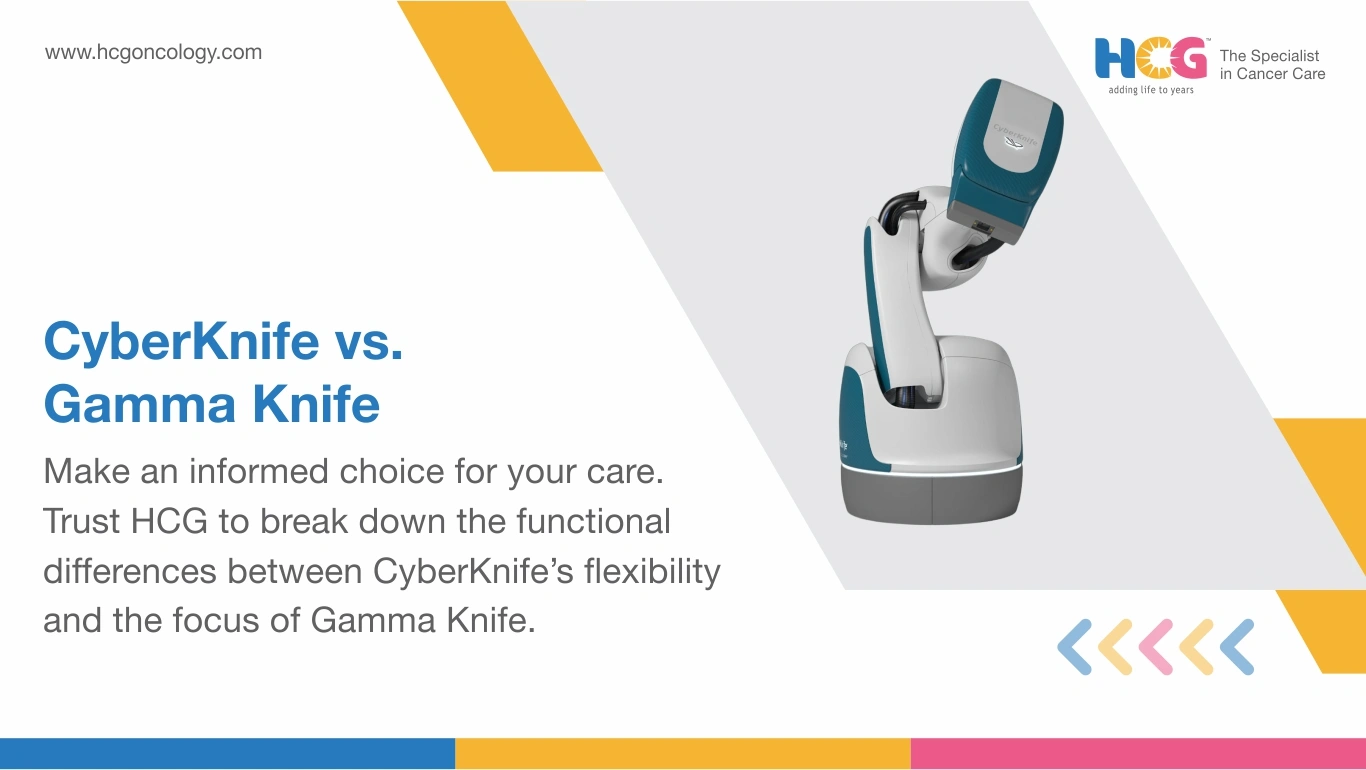
A small linear accelerator is attached to a flexible robotic arm, which uses high-energy beams to deliver radiation as part of advanced photon therapy. The arm repositions continuously during treatment, firing photon beams from hundreds of angles. Infrared cameras and live X-ray imaging track the target throughout. If the patient shifts even slightly, the arm self-corrects without stopping.
Before treatment, a simulation CT maps the tumor. Oncologists and physicists then complete dose planning, calculating beam angles and radiation distribution to cover the tumor while protecting surrounding tissue. For lung tumors, CyberKnife compensates for breathing movement in real time, making it uniquely suited for thoracic targets.
Inside Gamma Knife's hemispherical housing sit 192 cobalt-60 sources. Each emits focused gamma rays that converge precisely on intracranial targets, including tumors and skull lesions. All 192 converge at one intracranial point called the isocenter. Nothing moves. The skull provides the coordinate reference. Precision comes from convergence geometry, not mechanical motion.
| Feature | CyberKnife | Gamma Knife |
|---|---|---|
| Radiation source | Linear accelerator, photon beams up to 2000 directions | 192 cobalt-60 gamma ray sources |
| Treatment area | Brain, spine, lung, liver, prostate, pancreas | Brain and skull base only |
| Immobilization | Frameless, no head fixation | Stereotactic frame |
| Typical sessions | 1 to 5 fractions | Only 1 session |
| Real-time tracking | Yes, continuous robotic correction | Works on fixed coordinates using the frame fixed to the skull |
| SBRT capability | Yes | No |
| Available at HCG | Yes, CyberKnife treatment is available at HCG Bangalore and HCG Colaba. | Not available at HCG |
Both systems are widely used in brain metastases treatment, with the final choice depending on tumor location, number, and overall clinical context.
This is the most practical question patients ask. Understanding which system can physically reach your tumor type removes confusion early and helps you focus your consultation on the right treatment pathway.
| Tumor Type / Location | CyberKnife Eligible | Gamma Knife Eligible | Notes |
|---|---|---|---|
| Brain metastases | Yes | Yes | Both systems treat effectively; team experience guides choice. |
| Acoustic neuroma | Yes | Yes | Both are established options for vestibular schwannoma. |
| Meningioma | Yes | Yes | Comparable published outcomes for both platforms. |
| Arteriovenous malformation (AVM) | Yes | Yes | Both are used for intracranial AVMs. |
| Pituitary tumor | Yes | Yes | Both are suitable for appropriately sized lesions. |
| Trigeminal neuralgia | Yes | Yes | Gamma Knife has longer outcome data for this indication. |
| Glioma | Yes | Yes | Selected cases only; team assessment required. |
| Skull base tumors | Yes | Yes | Both platforms cover skull base anatomy. |
| Spinal tumors | Yes | No | CyberKnife only; Gamma Knife cannot access spinal anatomy. |
| Lung cancer (early stage / SBRT) | Yes | No | CyberKnife only; breathing motion tracking is essential. |
| Prostate cancer (SBRT) | Yes | No | CyberKnife only; Gamma Knife cannot treat pelvic targets. |
| Liver lesions | Yes | No | CyberKnife only; hepatic SBRT is well established. |
| Pancreatic tumors | Yes | No | CyberKnife only; complex dosimetry required. |
| Head and neck cancers | Yes | No | CyberKnife is only for extracranial head and neck targets. |
Both systems achieve sub-millimeter targeting accuracy for eligible cases, as confirmed in published radiosurgery literature. Gamma Knife's fixed isocenter geometry provides inherent consistency for intracranial targets. CyberKnife achieves comparable dose conformity through continuous real-time correction during delivery.
Gamma Knife typically completes treatment in one session, lasting 30 minutes to four hours. CyberKnife runs from one to five sessions. Spinal tumors often need three to five fractions to protect the cord. SBRT for lung or prostate targets typically uses three to five sessions on consecutive days.
The traditional Gamma Knife attached a rigid stereotactic frame to the skull under local anesthesia. CyberKnife has always been frameless. Patients lie on the couch with no head attachment, making it especially suitable for pediatric patients and those with claustrophobia.
Most patients return to normal activity within 24 to 48 hours after CyberKnife treatment. Fatigue is the most common effect in the first few days. Mild headache or nausea may briefly occur for brain targets. Skin irritation at body treatment sites typically resolves within two weeks.
A follow-up MRI is scheduled at six weeks and three months to assess the response. Psycho-oncology support and nutritional guidance are available throughout recovery at HCG centers.
HCG Cancer Hospital offers CyberKnife radiosurgery through structured multidisciplinary evaluation at NABH-accredited centers in Bangalore and Colaba, Mumbai. Every plan is built around the patient's tumor profile, anatomy, and clinical goals. Understanding how CyberKnife differs from Gamma Knife helps you arrive at your consultation better prepared, with sharper questions and a clearer sense of what your care team will discuss.
At HCG's CyberKnife centers in Bangalore and Colaba, Mumbai, every radiosurgery plan follows one principle: the right treatment, matched to the right patient, the first time.
Disclaimer:This information is intended to educate patients and caregivers. It does not replace professional medical advice. All treatment decisions should be made in consultation with a qualified doctor.
Dr. Unmesh Mukherjee
Consultant - Radiation Oncology
MBBS, MD (Radiotherapy)
Dr. Unmesh Mukherjee is a senior Radiation Oncologist at HCG ICS Khubchandani Cancer Centre, Colaba, specializing in precision radiation oncology. He has extensive expertise in advanced technologies such as CyberKnife, MR-LINAC, SRS, and SBRT, enabling highly targeted and effective cancer treatment. Dr. Mukherjee treats complex cancers, including brain tumors, breast cancer, and prostate cancer.
Appointment Link: Book an Appointment with Dr. Unmesh Mukherjee
Feel free to reach out to us.