25 Aug, 2026
25 Aug, 2026

This article is medically reviewed by Dr Shruthi Shivdas - Senior Consultant gynecological oncology.
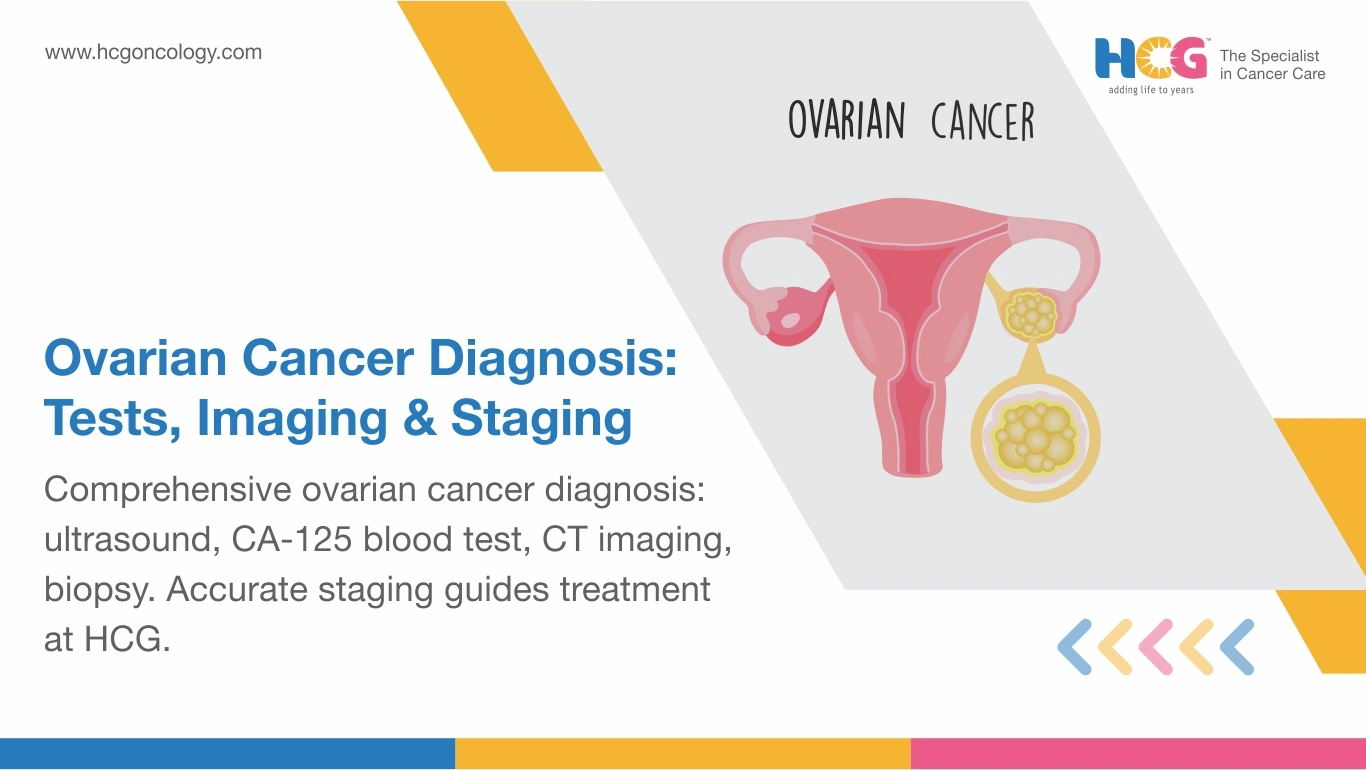
Diagnosing ovarian cancer involves several steps and generally begins with symptoms and a pelvic exam and progresses to a transvaginal ultrasound or CA-125 blood test. Due to the fact that there is no one test that can be used alone to diagnose the disease, specialists use a combination of these approaches to reach a diagnosis. Early detection is complicated by ambiguous symptoms and the absence of any screening for this condition for ordinary women.
Ovarian cancer diagnosis usually begins with a review of symptoms, medical history, and a pelvic examination. The examination helps identify any abnormalities that may require further evaluation through imaging or laboratory testing.
A transvaginal ultrasound is often one of the first diagnostic tests performed. It provides detailed images of the ovaries and helps identify whether a mass appears solid, cystic, or complex. However, ultrasound findings alone cannot determine whether a mass is benign or malignant.
But confirming cancer isn't something an ultrasound can do on its own. Structure is what it shows, not cell type. It's a bit like looking at the outside of a box without opening it; you can see the shape, but what's actually inside remains a mystery.
This combination of ovarian cancer tests helps doctors evaluate whether further imaging or biopsy is required.
Ovarian cancer imaging tests help determine tumor size, location, and possible spread to nearby organs. Advanced imaging follows when ultrasound flags something worth investigating. Here's how the main ovarian cancer imaging tests stack up:
Ultrasound can identify the presence and characteristics of an ovarian mass. Certain imaging features may increase suspicion for malignancy, but a definitive diagnosis requires additional testing and tissue evaluation.
Elevated CA-125 levels may be associated with ovarian cancer, but they can also occur in several non-cancerous conditions, including endometriosis, fibroids, and pelvic inflammatory disease. For this reason, CA-125 results are interpreted alongside imaging and clinical findings.
Cancer isn't what a high CA-125 automatically means. Endometriosis, fibroids, liver disease, and even pregnancy can push it up. Helpful but not definitive on its own is the best way to describe it.
What blood tests like CA-125 flag is risk, not diagnosis. Blood tests help assess the likelihood of ovarian cancer but are not sufficient to establish a diagnosis independently. ovarian tumor diagnosis always requires combining blood work with imaging and often a biopsy.
When imaging and laboratory findings suggest a possible malignancy, tissue sampling is required for confirmation. Histopathological examination of the tissue helps determine the cancer type, grade, and other characteristics that guide treatment planning.
First, a gynecologic oncology surgeon performs a diagnostic laparoscopy or open surgery. Second, the suspicious tissue gets removed and sent for histopathology (microscopic cell examination). Third, the pathologist confirms cell type and grade.
Most ovarian cysts are benign and often resolve without treatment. In contrast, malignant ovarian tumors typically persist, grow over time, and may be associated with additional findings such as ascites.
Ovarian cancer can sometimes be detected early, but there is no routine screening test for average-risk women. Early detection depends on symptom awareness, imaging, and high-risk screening in women with BRCA mutations or family history.
Three things work against early detection all at once.
What the early diagnosis of ovarian cancer depends on is awareness. Ovarian cancer diagnosis in younger women is rare, but women with a BRCA mutation or strong family history of ovarian cancer qualify as high-risk and should talk to their doctor about genetic testing.
Ovarian cancer diagnosis after menopause deserves extra attention because postmenopausal symptoms are may be mistakenly attributed to age-related changes.
Ovarian cancer diagnosis at HCG Cancer Hospital is At HCG Cancer Hospital, ovarian cancer evaluation is performed by gynecologic oncology specialists using a combination of clinical examination, imaging, laboratory testing, and biopsy when required.
which involves physical examination, ultrasound, CA-125 level measurement, and biopsy. As it is impossible to make an adequate diagnosis using only one test, multiple approaches are used for this purpose.
In case of cancer confirmation, further treatment will be determined depending on its stage, nature, and the patient's general state. Early diagnosis is especially recommended due to numerous advantages in this case. Book an ovarian cancer evaluation at your nearest HCG Cancer Hospital center for timely diagnosis and expert guidance.
Pelvic exam, transvaginal ultrasound, CA-125 blood test, and imaging comprise the ovarian cancer diagnosis protocol. No single test confirms it alone. Surgical biopsy with histopathology is what ultimately confirms an ovarian cancer diagnosis.
Usually transvaginal ultrasound alongside a CA-125 blood test. Together they show whether a suspicious ovarian mass exists. Neither confirms cancer alone, so doctors almost always order both rather than one individually.
Possible but tricky since no routine screening exists. Women with BRCA mutations or strong family history should pursue genetic testing and monitoring. Catching it early often depends on reporting persistent symptoms promptly.
Elevated CA-125 can mean ovarian cancer, but also endometriosis, fibroids, or infection. It flags risk rather than confirming diagnosis. Doctors pair it with imaging before drawing any real conclusions from it.
Cysts are fluid-filled, usually temporary, and often resolve naturally. Cancer produces complex growing masses that don't resolve and may cause ascites. Biopsy and histopathology confirm which one it actually is.
No. Ultrasound can detect an ovarian mass, but only biopsy can confirm cancer.
Dr Shruthi Shivdas
Senior Consultant gynecological oncology
Appointment Link: Book an Appointment with Dr Shruthi Shivdas
Feel free to reach out to us.