30 Jul, 2026
30 Jul, 2026
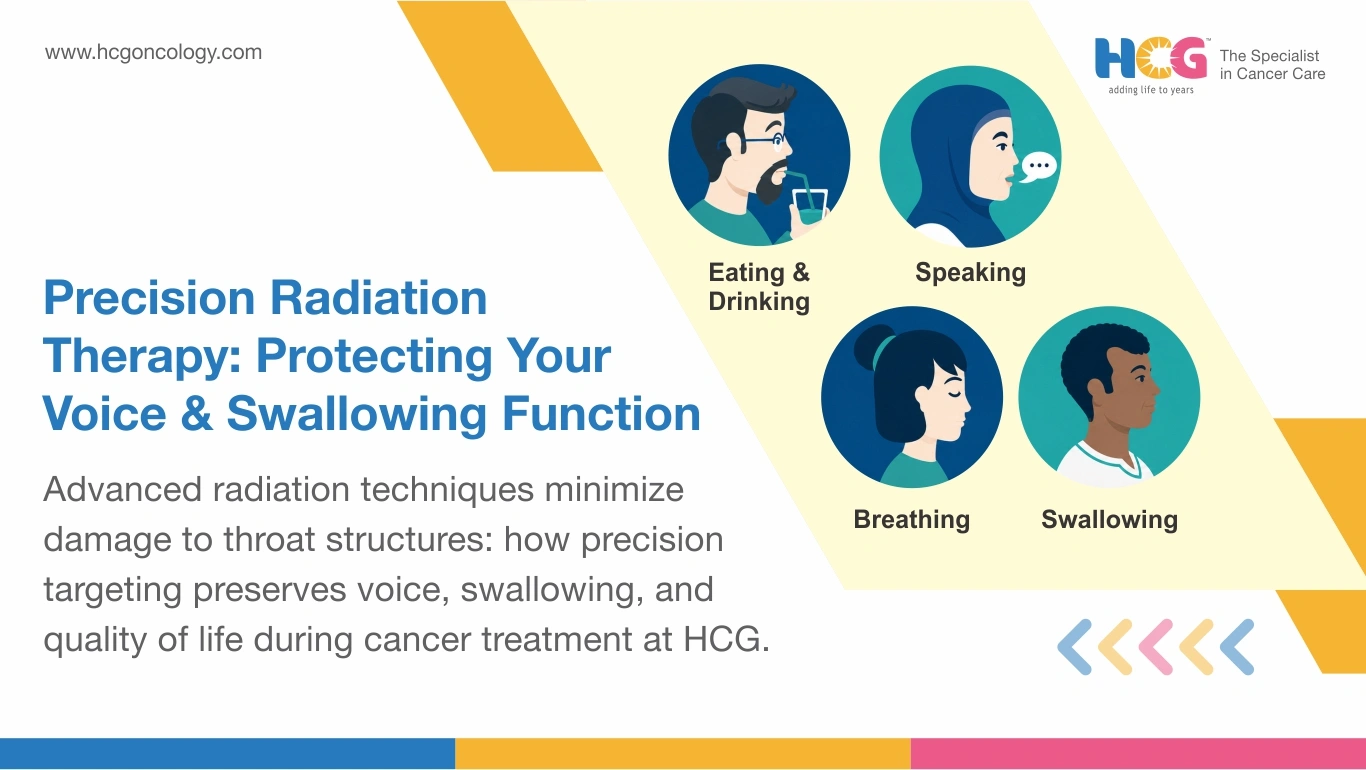
A cancer diagnosis in the head and neck region brings with it a specific kind of fear that many patients do not talk about openly. Beyond survival, people worry about whether they will still sound like themselves after treatment.
Whether they will be able to sit at a dinner table and eat normally. Whether radiation therapy will take something from them that cannot be given back. These are fair concerns, and they deserve honest answers.
Precision radiation therapy exists, in large part, because of exactly these concerns. Advanced radiation therapy techniques like IMRT and IGRT were developed to treat tumors without unnecessarily harming the structures around them.
For head and neck cancer patients, that means protecting the muscles, nerves, and glands that make speaking and swallowing possible. This blog walks through how that protection actually works and why it changes outcomes in ways that matter beyond the clinical numbers.
For decades, radiation therapy worked by directing beams at the tumor and accepting collateral damage to surrounding tissue as an unavoidable cost. In the head and neck region, the cost was steep.
The vocal cords, the pharyngeal muscles that coordinate swallowing, and the parotid and submandibular salivary glands, all of these sat within or very close to radiation fields and absorbed doses that left lasting marks.
Two conditions became almost expected in long-term survivors of conventional head and neck radiation.
The first is dysphagia, difficulty swallowing. Radiation stiffens the swallowing muscles, sometimes during treatment, sometimes months or years after.
The second is xerostomia, chronic dry mouth. The salivary glands sit close to common radiation fields and are often damaged. Without enough saliva, eating gets harder, speech dries out, and teeth start breaking down faster than expected.
Many patients do not notice it during treatment. It tends to settle in later, quietly, after they thought the worst was behind them.
The larynx sits in a difficult position when it comes to head and neck cancer. Even when it is not the primary tumor site, it frequently falls within the treatment area. Conventional radiation treated the larynx as an acceptable casualty. IMRT radiation therapy treats it as something worth protecting.
IMRT works by dividing the radiation beam into many smaller beamlets. Each beamlet can be independently adjusted in intensity. The planning system uses this flexibility to create a dose distribution that concentrates radiation at the tumor while pulling back from the structures around it.
The vocal cords and the delicate muscular structures that give them movement and tension can be mapped and intentionally kept below damaging dose thresholds.
Swallowing involves more than twenty muscles working in a precise, timed sequence. The pharyngeal constrictors, the muscles that squeeze food and liquid down toward the esophagus, wrap around the back of the throat and lie extremely close to where many head and neck tumors develop. When these muscles receive high radiation doses, they can fibrose, stiffen, and lose the flexibility that swallowing requires.
IMRT allows radiation oncologists to draw boundaries around the pharyngeal constrictors during treatment planning and deliberately limit the dose they receive. Swallowing preservation during radiation therapy becomes part of the treatment goal, something the entire plan is built around rather than something hoped for after the fact.
| Feature | Conventional Radiation | Precision Radiation Therapy |
|---|---|---|
| Beam Delivery | Broad, fixed fields | Shaped, modulated beamlets |
| Voice Impact | High risk of cord damage | Cord dose actively limited |
| Swallowing Impact | Muscle fibrosis common | Swallowing muscles mapped and spared |
| Salivary Gland Protection | Not a planning priority | Parotid sparing built into every plan |
| Healthy Tissue Sparing | Incidental at best | Central planning objective |
| Daily Accuracy | Standard positioning | Image-verified before every session |
Before any radiation is delivered, a simulation appointment takes place. The patient is positioned exactly as they will be for every treatment session. A custom immobilization device is created, a thermoplastic mask for head and neck cases. Detailed imaging is acquired in this position.
The radiation oncology team then spends considerable time contouring. This means outlining the tumor and every critical structure on the imaging data. The parotid glands, the submandibular glands, the pharyngeal constrictors, the larynx, the spinal cord, and the brainstem are each carefully delineated. Dose limits are assigned to every structure.
Side effects from head and neck radiation do not all appear on the same timeline. Some are present within the first week of treatment. Others peak in the weeks just after treatment ends. Some, particularly swallowing changes related to muscle fibrosis, can emerge six months or a year later.
Precision radiation therapy addresses all three phases. During treatment, salivary gland protection reduces the dryness and discomfort that makes eating and speaking difficult from early on.
After treatment, the lower doses to the swallowing muscles reduce the biological processes that lead to late fibrosis. Over the years that follow, patients show better functional trajectories and require fewer interventions to maintain the ability to eat and speak normally.
Common side effects that precision radiation therapy reduces in frequency and severity include:
Modern radiation therapy does not eliminate all side effects. The goal is to bring them within a range that allows people to live with dignity and function after cancer.
Radiation oncology research measures outcomes in dose-volume histograms and toxicity grades. Patients measure themselves in whether they can eat at a family gathering without embarrassment or whether they can talk on the phone without repeating themselves.
The benefits of precision radiation therapy come through in both ways:
Speech and swallowing therapists are often involved during treatment planning. Baseline assessments of voice and swallowing function before treatment begins give the clinical team a reference point. Exercises started early help maintain muscle strength and flexibility throughout the course of radiation, which makes recovery after treatment faster and more complete.
Patients who engage with swallowing therapy during radiation, rather than waiting until problems become obvious, consistently show better long-term outcomes. The muscles stay more flexible. The range of motion in swallowing is better preserved. Recovery after treatment is less intensive and less prolonged.
Healthy tissue sparing through targeted radiation therapy and proactive rehabilitation together give head and neck cancer patients the best realistic chance of coming through treatment with their voice and swallowing function meaningfully intact.
Precision oncology applies to radiation therapy the same principle that drives targeted drug therapy: understand the individual situation in detail and then act with specificity rather than broadly. In radiation oncology, this means knowing exactly where the tumor is, exactly where the critical structures are, and designing every aspect of treatment around that specific map.
For a head and neck cancer patient, this approach means the radiation oncologist is not just treating a cancer type. They are treating this particular tumor in this particular patient, accounting for where the salivary glands sit, how close the larynx is, which swallowing muscles are most at risk, and what dose each structure can safely receive.
That level of individualization is what modern radiation therapy offers that was simply not possible a generation ago.
Quality of life after head and neck cancer treatment has historically been one of the more difficult conversations in oncology. Survival rates have improved significantly over the decades, but the functional toll of treatment on voice, swallowing, and daily nutrition created a situation where many survivors struggled with the aftermath of the cure as much as with the disease itself.
Patients with head and neck cancer who come to HCG Cancer Hospital find a team that has spent years treating some of the most complex cases in this disease site. The radiation oncology department at HCG works with IMRT, IGRT, and VMAT platforms, and the clinical planning process is built around protecting the structures that matter most to a patient's daily life, including voice, swallowing, and salivary function.
Every case at HCG goes through a multidisciplinary tumor board. Radiation oncologists sit alongside surgical oncologists, medical oncologists, and other relevant specialists to review each patient's situation together.
The treatment plan that emerges from that process reflects not just what will control the tumor most effectively, but also what will allow the patient to speak, eat, and live as fully as possible after treatment.
Disclaimer: This article is for general informational purposes only and is not a substitute for professional medical advice, diagnosis, or treatment. Please consult a qualified healthcare provider for any questions regarding a medical condition.

Dr. Trinanjan Basu
Senior Consultant & HOD - Radiation Oncology
MBBS, MD (Radiation Oncology), CAS-Pr (Switzerland)
Dr. Trinanjan Basu is one of Mumbai's reputed medical oncologists. His expertise lies in the treatment of benign and malignant brain tumors and head and neck cancers through IMRT/VMAT, and the application of SRS/SBRT in brain, spine, lung, and prostate malignancies. He is experienced in PET-CT-based treatment planning and evaluation for head and neck malignancies and has developed better techniques to spare normal structures and improve quality of life.
Appointment Link: Book an Appointment with Dr. Trinanjan Basu.
Feel free to reach out to us.