25 Aug, 2026
25 Aug, 2026
This article is medically reviewed by Dr Rajesh Jokka Consultant - Medical Oncologist.
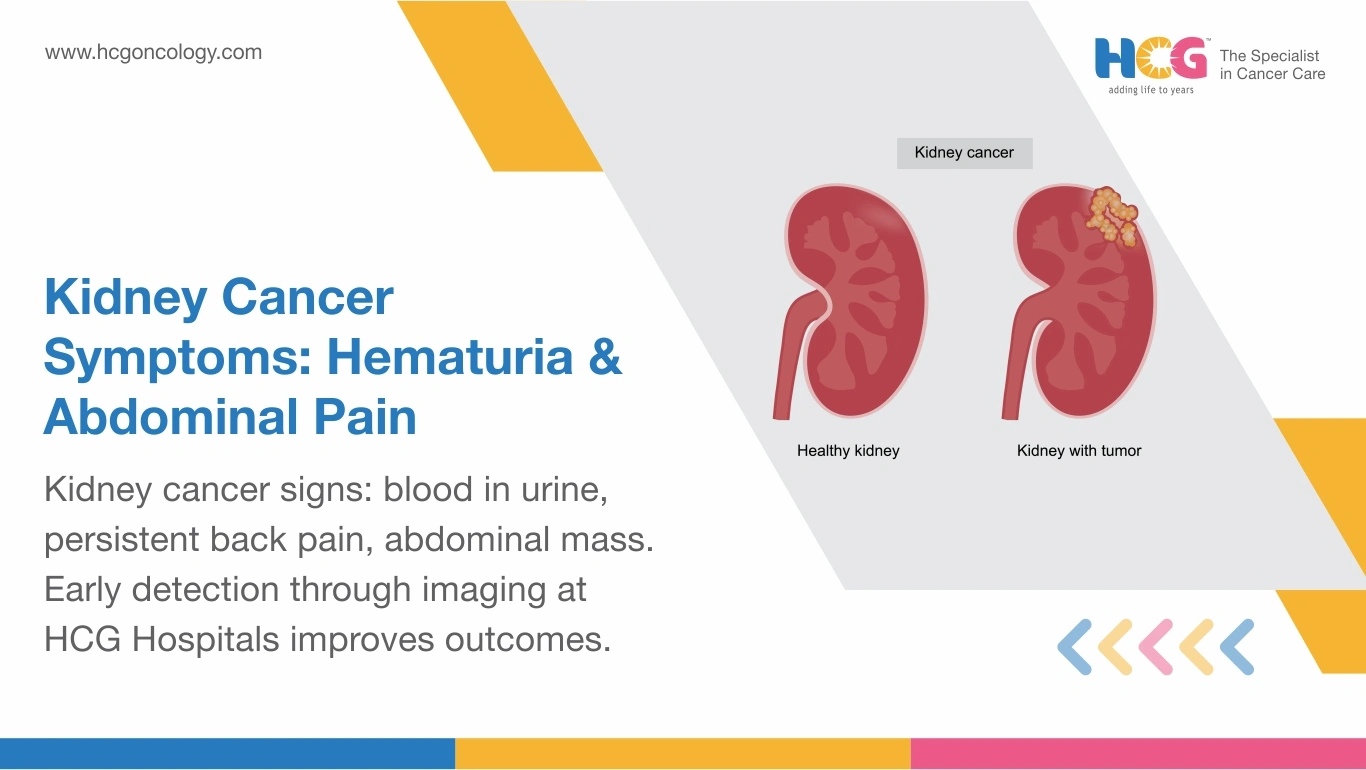
Kidney cancer is often detected late because early-stage tumors may not cause noticeable symptoms. Warning signs can include blood in the urine, persistent flank pain, fatigue, unexplained weight loss, or swelling near the kidney area.
Kidney cancer develops when abnormal cells grow uncontrollably inside the kidney. Most people don't have symptoms until the tumor has been growing for a while.
Early kidney cancer symptoms are often mistaken for kidney stones or urinary infections. Published data show that kidney cancer is among the top ten cancers diagnosed in adults, and in India, the numbers have been rising. Catching the warning signs early gives doctors more options.
It can. Many kidney cancers are discovered accidentally during scans done for unrelated health problems of the abdomen or an ultrasound of the kidney ordered for something completely different. Research published in BMC Urology shows that renal cell carcinoma accounts for roughly 90 percent of kidney cancers, and a large number of cases are found incidentally during imaging for other issues.
When symptoms appear, the most common early signs include blood in the urine (hematuria), a dull ache in the side or lower back, and unexplained fatigue. In India, kidney cancer is rising, particularly among men over 50 with a smoking risk history, which makes awareness of these symptoms more important than ever.
Kidney cancer should be evaluated when symptoms persist without a clear explanation
First, blood in urine that comes and goes without pain is one of the most notable warning signs.
Second, persistent back pain that doesn't respond to rest or physical therapy deserves further investigation.
Third, unexplained weight loss paired with fatigue and kidney cancer symptoms that linger beyond a few weeks should prompt a visit to a specialist.
Kidney cancer becomes more concerning when multiple symptoms appear together, and a single symptom on its own rarely points directly to a kidney tumor. It's when two or three show up together that the picture changes; doctors may then recommend imaging tests to rule out serious conditions.
One of the most common warning signs is blood in the urine (hematuria).” Blood in urine causes include infections, stones, and trauma, but when it's painless and recurrent, kidney cancer moves higher on the list of possible causes. Is blood in urine always kidney cancer? It isn't. Most cases of hematuria aren't cancer, but the ones that are tend to be caught through this symptom. Doctors usually recommend imaging tests to evaluate the kidneys and urinary tract.
It can, especially when the tumor grows large enough to press on surrounding structures. Back pain linked to kidney cancer is usually one-sided, dull, and persistent. Kidney pain and cancer feel different from muscle strain. The pain tends to be deeper, more constant, and sometimes radiates toward the abdomen.
But a diagnosis isn't what back pain alone provides. It's a reason to investigate further, especially if other symptoms are present at the same time. Most back pain is not caused by cancer, but the cases that are cancer are the ones where early evaluation makes the biggest difference.
A red flag across many cancers is losing weight without trying. Unexplained weight loss in kidney cancer may occur because tumors can affect the body’s metabolism (a condition where the tumor produces substances that affect metabolism and other body functions). Fatigue and kidney cancer symptoms often accompany weight loss, creating a pattern that warrants blood work and imaging.
Kidney stones and kidney cancer can share symptoms, but they are very different conditions. Understanding the differences helps patients and doctors determine the right course of action.
Here's how they compare:
| Feature | Kidney Stone | Kidney Cancer |
|---|---|---|
| Pain type | Sharp, colicky, comes in waves | Dull, persistent, one-sided |
| Blood in urine | Common, usually with pain | Often painless |
| Weight loss | Not typical | May occur |
| Fever | Possible with infection | Rare early on |
| Imaging finding | Stone visible on CT | Mass or kidney tumor visible |
What does kidney cancer pain feel like? A steady ache in the flank or lower back that doesn't go away is how it's typically described. Less of a stabbing sensation and more of a persistent pressure that continues regardless of position changes.
Kidney cancer symptoms are largely similar in both men and women. . Both experience hematuria, pain, and fatigue. However, what women sometimes do is attribute early symptoms to menstrual changes or urinary infections, which can delay evaluation and lead to later-stage diagnosis.
Women's kidney cancer symptoms get dismissed more often, not because the signs are different, but because the first assumptions point elsewhere.
When symptoms raise a flag, a structured path is what a kidney cancer diagnosis follows. An ultrasound of the kidney or a CT scan of the abdomen identifies the kidney mass, and if the mass looks suspicious, an MRI of the kidney provides additional detail about its composition and extent.
A biopsy then confirms whether cells are cancerous, though many urologists proceed directly to surgery when imaging is clear enough to support a confident diagnosis. What kidney cancer stages at diagnosis shape considerably is the treatment plan.
First, early-stage tumors often need only a partial nephrectomy (removal of part of the kidney), which preserves kidney function. Second, more advanced stages with renal vein involvement or metastatic kidney cancer require a broader treatment approach that may include systemic therapy. Third, genetic evaluation matters for younger patients because the VHL gene and HIF-2a pathway play a role in certain inherited kidney cancers. Most oncologists agree that staging accuracy is what drives treatment success.
The biggest modifiable factor for kidney cancer is smoking risk. Hypertension and obesity follow as the next most significant risk factors. What reducing or eliminating these risk factors can meaningfully lower your chances of developing the disease.
Kidney cancer stages range from stage 1 (tumor confined to the kidney, under 7 cm) to stage 4 (metastatic kidney cancer that has spread to distant organs). Better treatment response is what the earlier stages give you, which is why paying attention to kidney cancer warning signs matters. In most cases, though not all, many kidney cancers could be caught sooner if screening were more common among high-risk groups.
HCG Cancer Hospital’s urologic oncology teams support patients through every stage of kidney cancer evaluation, from imaging and biopsy to staging and treatment planning. Care is guided by each patient’s diagnosis, overall health, and disease profile.
Patients can expect access to advanced imaging technologies, experienced uro-oncology specialists, and comprehensive staging assessments that help shape individualized treatment plans. Multidisciplinary consultations involving urologists, medical oncologists, radiologists, and other specialists are also part of the coordinated care approach at HCG Cancer Hospital.
At HCG Cancer Hospital, the same team follows you from that first suspicious scan through staging, treatment decisions, and follow-up. Learn about early cancer warning signs that shouldn't be ignored.
Book a kidney cancer evaluation at your nearest HCG Cancer Hospital center.
Disclaimer: This article is for general informational purposes only and is not a substitute for professional medical advice, diagnosis, or treatment. Please consult a qualified healthcare provider for any questions regarding a medical condition.
Dr Rajesh Jokka
Consultant - Medical Oncologist
Feel free to reach out to us.