02 May, 2026
02 May, 2026
A throat cancer diagnosis raises one immediate question: What can actually be done? The answer depends on where the tumor sits, whether it involves the larynx, pharynx, or hypopharynx, how far it has spread, and how well the patient's body can handle treatment. Five core modalities exist: surgery, radiation therapy, chemotherapy, targeted therapy, and immunotherapy. Most patients receive a carefully sequenced combination rather than a single approach. At HCG, every treatment plan is built through a multidisciplinary tumor board where surgical, radiation, and medical oncology expertise collectively shape the decisions.
| Stage | Primary Approach | Clinical Goal |
|---|---|---|
| Stage I | Radiation or transoral surgery | Cure with full function preserved |
| Stage II | Radiation or limited surgery | Cure with minimal side effects |
| Stage III | Concurrent chemoradiation | Organ preservation, disease control |
| Stage IV (local) | Chemoradiation or surgery plus adjuvant therapy | Disease control, functional balance |
| Stage IV (metastatic) | Chemotherapy plus immunotherapy | Systemic control, quality of life |
Good to Know: Stage tells your doctor how far the cancer has traveled. It does not, by itself, predict your individual outcome.
| Stage | Primary Treatment Type | Clinical Goal |
|---|---|---|
| Stage I | Radiation or Surgery | Cure with full function preserved |
| Stage II | Radiation or Limited Surgery | Cure with minimal side effects |
| Stage III | Chemotherapy + Radiation (Concurrent Chemoradiation) | Organ preservation, disease control |
| Stage IV (Local) | Chemoradiation or Surgery + Adjuvant Therapy | Disease control, functional balance |
| Stage IV (Metastatic) | Chemotherapy + Immunotherapy | Systemic control, quality of life |
Surgery means physically removing the tumor and, where needed, the surrounding tissue and regional lymph nodes. The surgical team's priority is complete tumor clearance while protecting the structures that govern speech, swallowing, and breathing.
The procedure depends on exactly where the tumor is located.
Common Confusion: Surgery does not always mean losing your voice. Transoral and partial procedures preserve voice in many early-stage patients.
HCG's surgical oncology teams handle complex head and neck reconstruction, including microvascular free-flap procedures critical for restoring swallowing function after large resections.
Radiation therapy for throat cancer directs precisely calibrated ionizing energy at the tumor while limiting exposure to the spinal cord, salivary glands, jaw, and surrounding soft tissue.
Four main delivery techniques are used at HCG:
IMRT modulates beam intensity to conform tightly to the tumor's irregular shape, reducing dry mouth and oral mucositis (that raw, inflamed feeling inside the mouth and throat) compared to conventional radiation.
IGRT uses daily imaging before each fraction to correct for anatomical shifts as the tumor responds and shrinks.
VMAT delivers the full prescribed dose during a single rotating arc, shortening each treatment session considerably.
SBRT applies ablative, high-dose radiation in 3 to 5 sessions for small, precisely defined recurrent lesions.
At HCG, the Radixact adaptive radiotherapy platform and Ethos AI-driven system can modify the treatment plan mid-course, an important capability for head and neck tumors that frequently change shape during treatment.
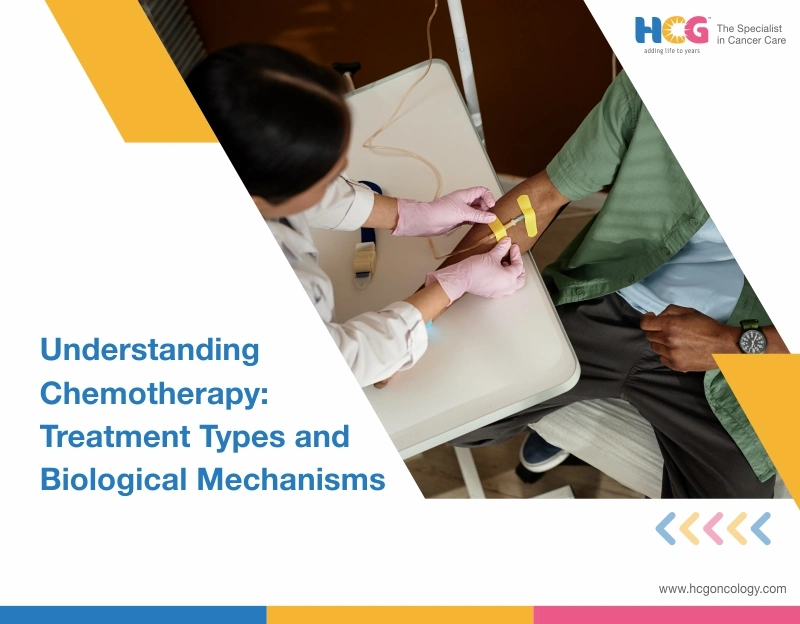
Chemotherapy for throat cancer disrupts the ability of rapidly dividing cancer cells to replicate. It serves two roles in throat cancer management.
The first is concurrent delivery alongside radiation, acting as a radiosensitizer that makes tumor cells more vulnerable to each radiation fraction. The second is induction chemotherapy, given before definitive treatment to reduce tumor bulk and test how the cancer responds before committing to a full course.
Platinum-based regimens are the standard concurrent option. Side effects, including nausea, mucositis, fatigue, and temporary kidney stress, are actively managed through HCG's supportive care protocols. Most patients receive infusions at HCG's Day Care Chemotherapy Units and return home the same day.
| Factor | Surgery | Radiation Therapy | Chemotherapy |
|---|---|---|---|
| Treatment method | Physical tumor removal | High-energy beams destroy cancer cells | Anti-cancer drugs kill fast-growing cells |
| Main role | Remove visible disease | Destroy the tumor while preserving the organs | Enhance radiation or shrink tumors |
| When commonly used | Early-stage or resectable tumors | Early-stage or organ-preservation cases | Locally advanced or metastatic disease |
| Goal | Tumor clearance with functional preservation | Organ preservation & local control | Systemic control & radiosensitization |
| Delivery | Operation theatre procedure | Outpatient radiation sessions | IV infusions in cycles |
| Function impact | May affect voice/swallowing depending on the extent | Usually preserves voice & structure | Temporary systemic side effects |
Yes. For many locally advanced throat cancers, particularly those in the larynx and oropharynx, definitive chemoradiation is a guideline-backed alternative to surgery. Oncological outcomes are comparable in carefully selected patients, and the patients retain their natural voice and swallowing functions. This decision requires a multidisciplinary tumor board review, not a single-specialist opinion.
Targeted therapy for throat cancer blocks the molecular signals a tumor depends on to grow. Cetuximab, directed against the epidermal growth factor receptor (EGFR), is used alongside radiation for patients who cannot safely receive platinum chemotherapy. At HCG, Triesta Sciences' genomic profiling identifies additional mutation-specific targets that may extend targeted therapy eligibility.
Immunotherapy for throat cancer works differently. Checkpoint inhibitors like pembrolizumab and nivolumab block the PD-1 and PD-L1 proteins that cancer cells use to hide from the immune system. Once unmasked, the body's own T-cells can recognize and destroy the tumor. These agents are approved for recurrent or metastatic squamous cell carcinoma of the head and neck, particularly in tumors with high PD-L1 expression.
In summary, immunotherapy is most relevant in recurrent, metastatic, or high PD-L1-expressing disease. It is not a standard first-line option for all throat cancer patients.
Recovery is a structured clinical process. It begins during treatment.
Speech and swallowing rehabilitation: A speech-language pathologist designs a targeted exercise program to prevent progressive muscle stiffening in the throat.
Nutritional support: Many patients need temporary tube feeding during chemoradiation as swallowing becomes too painful. A dietitian guides the return to oral intake as inflammation resolves.
Follow-up imaging: A PET-CT scan at 8 to 12 weeks post-treatment confirms tumor response. Surveillance continues at defined intervals.
Thyroid monitoring: Neck radiation affects thyroid function in a significant proportion of patients. Annual TSH checks and hormone supplementation are standard where needed.
Psycho-oncology support: HCG provides counseling, yoga therapy, and integrative programs to address the emotional weight of voice changes, altered appearance, and treatment fatigue.
Radiation therapy packages range from Rs. 2.5 lakh to Rs. 12 lakh. Surgical procedures range from Rs. 1.5 lakh to Rs. 6 lakh, with complex reconstruction adding to that range. Chemotherapy and immunotherapy carry additional per-cycle costs.
Costs vary by hospital and patient profile. Metropolitan centers like Bengaluru, Mumbai, and Hyderabad generally reflect higher facility charges than Tier 2 cities. Ayushman Bharat and other government schemes cover eligible patients. HCG's patient navigation team can identify applicable financial support pathways.
For many patients, the most helpful next step is simply getting the right team around the table before treatment begins. HCG Cancer Hospital structures every case through a tumor board, bringing together surgical, radiation, and medical oncology expertise to build a plan that balances cancer control with the patient's functional life after treatment.
Next Steps for Your Doctor Visit:
Disclaimer: This information is intended to educate patients and caregivers. It does not replace professional medical advice. All treatment decisions should be made in consultation with a qualified doctor.
Feel free to reach out to us.