25 Aug, 2026
25 Aug, 2026
Many cancers begin to change the way cells function long before a tumor can be seen on a routine scan. A PET scan helps doctors spot these changes by highlighting areas of unusually high metabolic activity, which may indicate the presence or spread of cancer.
Because PET scans are often combined with CT imaging, doctors can see both how tissues look and how they are behaving. This information plays an important role in diagnosing cancer, determining its stage, and evaluating how well treatment is working.
A PET scan (positron emission tomography) is a nuclear medicine imaging test that looks for aberrant cell activity by using a radiotracer. It is widely used in oncology imaging for cancer diagnosis, evaluation of tumor activity, and detection of recurrence.
A tiny amount of radioactive material, known as a radiotracer, is injected into your bloodstream. This is a glucose-based molecule known as FDG.
Why glucose? Cancerous cells take up more FDG than healthy tissue because their glucose metabolism (how quickly cells burn sugar for energy) is higher than usual. The PET scanner picks up this uptake and makes images showing where metabolic activity appears abnormal.
Why is a PET scan done? Finding cancer. Watching how well the treatment is working. Looking for cancer coming back.
This is called metabolic imaging, where areas of high FDG uptake can signal increased glucose metabolism, as is typically found in cancer cells.
Understanding PET scans vs. CT scans helps patients know why both tests are often used together in cancer diagnosis and staging.
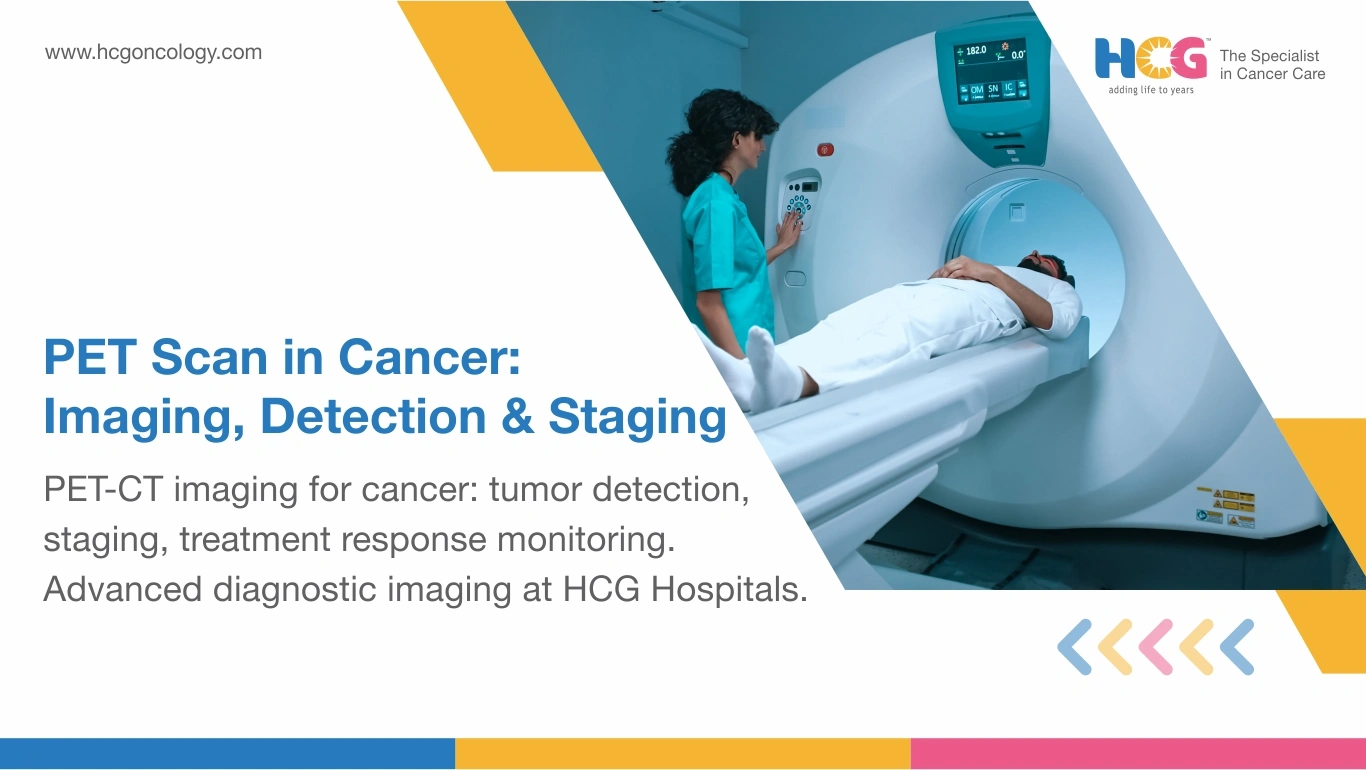
A PET scan and a CT scan are complementary tools that each deliver different types of information. Most PET scans today are performed as PET-CT scans, a form of hybrid imaging that merges metabolic data from PET with the anatomical detail from CT in a single session.
Getting accurate results depends on proper preparation.
PET scan preparation instructions also include wearing comfortable clothing and removing metal jewelry. You'll receive the radiotracer injection about an hour before scanning. During that waiting period, resting quietly while the tracer distributes through your body is what's expected.
How long does a PET scan take? The injection and waiting period take about an hour. The scan itself takes 30 to 45 minutes. Plan for roughly two hours total at the nuclear medicine department.
You lie on a narrow table that slides through a ring-shaped scanner. In most oncology cases, this is a whole-body PET scan, imaging from the base of the skull to the mid-thigh to capture any spread across major organ systems. It's quiet and painless. Nothing to feel during the scan itself. The machine captures images as the table moves slowly through the ring.
Increased SUV suggests more metabolic activity in a particular area. This could be the case in many other conditions, such as infections and inflammation, apart from cancer. It is wrong to suggest that a positive PET scan is suggestive of cancer.
How accurate is a PET scan for cancer? Very accurate for most solid tumors. But interpretation requires experience. Your oncologist reads PET scan results alongside clinical history and other test results.
A PET scan is a powerful diagnostic tool, but it works best as one piece of a larger diagnostic picture. PET scan results show areas of increased metabolic activity using SUV values. Higher SUV values may indicate cancer but can also occur due to infection or inflammation, requiring clinical correlation.
When cancer is diagnosed, it finds the primary tumor, looks at nearby lymph nodes, and picks up distant metastasis in organs far from where the cancer started.
A PET scan diagnosis earns its place here more than anywhere else. Tumor staging and cancer staging both lean heavily on what PET imaging reveals.
Different cancers behave differently on PET imaging. A PET scan for breast cancer catches distant spread after initial diagnosis, particularly to bones, liver, and lungs.
A PET scan for lung cancer handles both staging and tracking treatment response, showing whether disease has reached lymph nodes or elsewhere. A PET scan for lymphoma is among the most common applications because lymphoma cells run high on metabolic activity and show up clearly every time.
Can a PET scan detect all cancers? Some slow-growing tumors don't absorb enough FDG to show up clearly on imaging. Certain cancers, including some prostate and kidney cancers, can be missed on standard PET scans because their metabolic rates aren't high enough to produce a strong signal.
But a PET scan can detect cancer recurrence effectively. PET scan after chemotherapy reveals whether residual tumor activity remains, helping doctors decide if treatment worked or if additional therapy is needed.
PET scans are considered safe and are widely used in nuclear medicine imaging, with minimal radiation exposure compared to their diagnostic benefits.
Minimal side effects: The radiotracer dose is small and leaves your body within hours through natural excretion. Most patients feel nothing during or after the scan.
But there are precautions worth knowing. Pregnant women should avoid PET scans due to radiation exposure.
Drinking plenty of water after the scan helps flush the radiotracer from your system more quickly. Radiation exposure from a PET scan is comparable to what you'd get from a standard CT scan, and the diagnostic benefit almost always outweighs the small risk involved.
The nuclear medicine department and the oncology imaging team at HCG Cancer Hospital conduct PET-CT scans on patients for various reasons such as staging cancer, monitoring treatment, and assessing recurrence of cancer. This procedure is carried out at a single place to make things convenient for everyone involved.
Through the help of modern imaging technology and proper interpretation of the scan reports, previously conducted scans are reviewed to see if there have been any changes.
Book a PET scan appointment at your nearest HCG Cancer Hospital.
Disclaimer: This article is for general informational purposes only and is not a substitute for professional medical advice, diagnosis, or treatment. Please consult a qualified healthcare provider for any questions regarding a medical condition.
Feel free to reach out to us.